
How to Improve Concentration in Studies: 15 Proven Tips That Actually Work

You open your textbook. You read the same line four times. Still nothing sticks.
Sound familiar? You’re not alone – and you’re definitely not lazy.
Every day, millions of students sit down with full intention of studying -yet walk away having absorbed almost nothing. Distractions hijack focus. Stress clouds thinking. Hours disappear without real progress.
Here’s the hard truth-poor concentration costs you grades, confidence, and time you can never get back.
But here’s the better truth-how to improve concentration in studies doesn’t require superhuman willpower. It requires the right strategies, applied consistently.
This guide gives you exactly that –15 battle-tested, science-backed tips that real students use to sharpen focus, retain more, and finally study with purpose.
Ready? Let’s fix your focus-starting today.
Why Is It Hard to Concentrate While Studying?
Honestly, struggling with focus doesn’t mean you’re lazy. Your brain faces real challenges every single day.
Modern life throws distractions at you constantly. Social media, noise, stress, bad sleep-all of these quietly destroy your ability to stay locked in during study sessions.
Understanding why your concentration breaks down helps you fix it faster.
Common Causes of Poor Concentration in Students
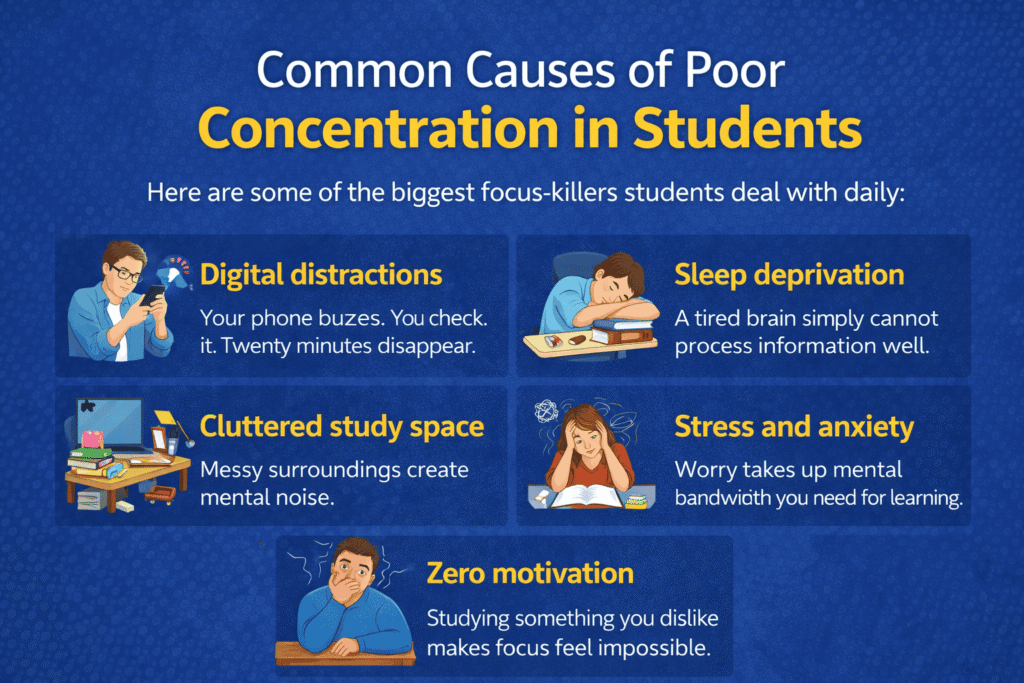
Here are some of the biggest focus-killers students deal with daily:
- Digital distractions – Your phone buzzes. You check it. Twenty minutes disappear.
- Sleep deprivation – A tired brain simply cannot process information well.
- Cluttered study space – Messy surroundings create mental noise.
- Stress and anxiety – Worry takes up mental bandwidth you need for learning.
- Zero motivation – Studying something you dislike makes focus feel impossible.
Do any of these hit close to home? You’re definitely not alone.
How Lack of Focus Affects Academic Performance
Broken concentration doesn’t just slow you down. It quietly damages your results over time.
When your attention and memory keep getting disrupted, your brain struggles to retain new information. You spend twice the time — getting half the results.
Worse, repeated study failures build anxiety. Anxiety wrecks focus even more. It becomes a painful cycle that feels hard to escape.
How to Improve Concentration in Studies: 15 Proven Tips
Let’s get into the actual solutions. These tips work- but only if you apply them consistently.
Tip 1: Create a Dedicated Study Environment
Your brain loves patterns. Studying in the same spot daily trains your mind to enter focus mode automatically.
Pick one clean, quiet corner for all your study sessions. Remove clutter, set up good lighting, and keep your phone out of arm’s reach.
A distraction-free environment signals your brain-it’s time to work now.
Tip 2: Follow the Pomodoro Technique
Here’s a method that changed how millions of students study worldwide.
Work for 25 minutes straight. Take a 5-minute break. Repeat four times -then take a longer 20-minute rest.
This approach, called the Pomodoro Technique, prevents mental fatigue and keeps your brain sharp across longer sessions. Apps like Forest or Pomofocus make tracking this super easy.
Tip 3: Set Clear Study Goals Before Each Session
Walking into a study session without a plan wastes precious time.
Before opening your books, write down exactly what you want to finish. Break big subjects into smaller, manageable chunks.
Time management for students starts with knowing your target before you begin-not after you’ve already sat down.
Tip 4: Eliminate Digital Distractions
Your phone isn’t just a distraction. It actively trains your brain toward short attention spans.
Put your phone in another room during study blocks. Use website blockers like Freedomor Cold Turkey to cut off social media access completely.
Reducing study distractions even slightly can dramatically improve your session quality within days.
Tip 5: Practice Mindfulness and Meditation
This one surprises most students — but science backs it completely.
Just 5–10 minutes of breathing exercises before studying calm your nervous system. They clear mental clutter and prime your brain for deep focus.
Mindfulness for students isn’t about sitting still and doing nothing. It actively reshapes your brain’s ability to concentrate over weeks of practice.
Try apps like Headspace or Calm – even the free versions help significantly.
Tip 6: Get Adequate Sleep Every Night
No productivity hack replaces quality sleep. Not even close.
During deep sleep, your brain consolidates everything you studied earlier that day. Skip sleep- and that information disappears before your exam.
Students need 7-9 hours nightly for peak cognitive performance. Going to bed at the same time each night builds a sleep rhythm your brain genuinely loves.
Tip 7: Exercise Regularly to Boost Brain Power
Physical movement directly boosts brain function. That’s not motivation talk — that’s neuroscience.
Exercise increases BDNF (brain-derived neurotrophic factor) — a protein that strengthens brain cell connections. Better connections mean sharper focus and stronger memory.
A 30-minute morning walk before studying can visibly improve your attention span throughout the entire day. Even light yoga works wonders for mental clarity.
Tip 8: Eat Brain-Boosting Foods
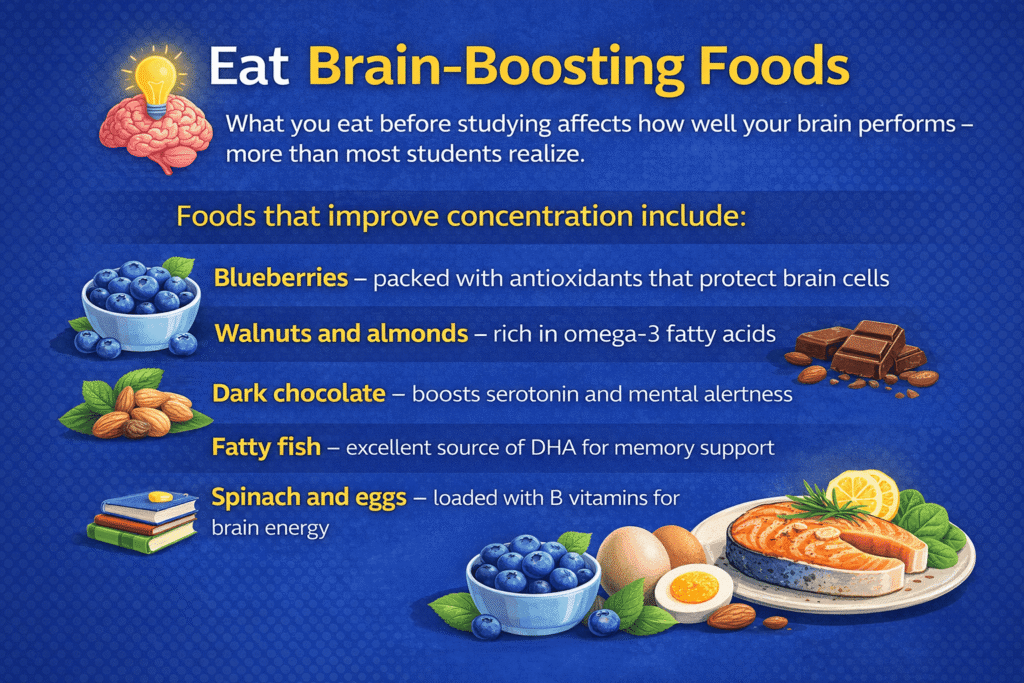
What you eat before studying affects how well your brain performs- more than most students realize.
Foods that improve concentration include:
- Blueberries – packed with antioxidants that protect brain cells
- Walnuts and almonds – rich in omega-3 fatty acids
- Dark chocolate – boosts serotonin and mental alertness
- Fatty fish – excellent source of DHA for memory support
- Spinach and eggs – loaded with B vitamins for brain energy
Avoid sugary snacks and heavy meals right before a session. Sugar spikes crash hard — taking your focus down with them.
Tip 9: Use Active Recall and Spaced Repetition
Most students reread their notes repeatedly. That approach barely works.
Active recall means testing yourself on material instead of passively reviewing. Close your notes. Try recalling key concepts from memory. Check your answers. Repeat.
Pair this with spaced repetition — reviewing content at growing intervals over time. Tools like Anki make this incredibly simple.
Together, these two techniques dramatically improve both working memory and long-term retention.
Tip 10: Listen to Focus-Enhancing Music
Not all music distracts you. Some types actually push your brain deeper into concentration.
Lo-fi beats, binaural audio, and white noise create a steady mental environment that blocks out irregular background sounds.
Avoid music with lyrics during heavy reading or writing tasks. Save lyric-heavy playlists for breaks instead. Try Brain.fm for scientifically designed focus audio.
Tip 11: Take Effective Breaks — Not Scrolling Sessions
Breaks recharge your brain. But only if you use them correctly.
Scrolling social media during breaks doesn’t rest your mind — it actually overstimulates it further. Your brain needs genuine downtime.
During breaks, stretch your body, take a short walk, drink water, or simply stare out a window. Student productivity improves significantly when breaks actually restore energy rather than drain it further.
Tip 12: Manage Stress and Study Anxiety
Stress and concentration cannot coexist comfortably. One always wins – and stress usually does.
High anxiety floods your brain with cortisol, which actively blocks memory formation. Managing stress isn’t optional for students — it’s part of academic performance.
Try journaling before study sessions. Write down your worries on paper, then set that paper aside. This simple habit mentally separates your emotional load from your study time.
Tip 13: Try the “Deep Work” Method
Author Cal Newport calls it Deep Work – and it’s one of the most powerful focus strategies available today.
Schedule 60–90 minute blocks of completely uninterrupted, high-intensity study. No phone. No background noise. No multitasking whatsoever.
Deep work trains your brain’s ability to sustain focus over longer periods – a skill that compounds powerfully over weeks and months of practice.
Tip 14: Stay Hydrated Throughout Study Sessions
Most students forget this completely – yet it makes a real difference.
Even mild dehydration reduces concentration, triggers headaches, and slows thinking speed noticeably. Your brain runs on water just as much as it runs on sleep.
Keep a water bottle at your desk. Aim for 6–8 glasses daily during active study days. Green tea works great too — offering gentle caffeine plus L-theanine, a compound known for promoting calm, steady focus.
Tip 15: Build a Consistent Daily Study Routine
Motivation comes and goes. Routine stays.
Building a study schedule at consistent times each day removes the mental debate of “when should I study?” Your brain stops negotiating — and just starts working.
Start small. Study for 30 minutes daily at the same time. Add more gradually. Consistency beats intensity every single time when building lasting concentration habits.
Quick-Reference: Study Concentration Tips at a Glance
| # | Tip | Benefit | Difficulty |
| 1 | Dedicated Study Space | Reduces distractions | Easy |
| 2 | Pomodoro Technique | Prevents burnout | Easy |
| 3 | SMART Goal Setting | Increases direction | Easy |
| 4 | Digital Detox | Boosts focus | Medium |
| 5 | Mindfulness/Meditation | Rewires brain | Medium |
| 6 | Quality Sleep | Memory consolidation | Easy |
| 7 | Regular Exercise | Increases BDNF | Medium |
| 8 | Brain-Boosting Diet | Fuels cognition | Easy |
| 9 | Active Recall | Strengthens memory | Medium |
| 10 | Focus Music | Enhances deep focus | Easy |
| 11 | Effective Breaks | Restores energy | Easy |
| 12 | Stress Management | Clears mental fog | Medium |
| 13 | Deep Work Method | Maximizes output | Hard |
| 14 | Stay Hydrated | Brain performance | Easy |
| 15 | Daily Study Routine | Builds consistency | Medium |
How Long Does It Take to Improve Concentration?
Students often want fast results – and honestly, some come quickly.
Within 1–2 weeks of consistent practice, most students notice meaningful improvements. Distractions feel less powerful. Study sessions feel less exhausting.
Deeper neurological changes – actual brain rewiring through neuroplasticity- happen over 4–8 weeks of daily effort. Your prefrontal cortex literally grows stronger connections for sustained focus.
Track your progress weekly. Note how long you studied without losing focus. Small wins stack up fast and build genuine momentum.
Best Tools and Apps to Help You Focus While Studying
| Tool | Purpose | Platform |
| Forest App | Phone-free focus sessions | iOS / Android |
| Freedom | Block distracting websites | All devices |
| Anki | Spaced repetition flashcards | All devices |
| Notion | Study planner and organizer | All devices |
| Headspace | Mindfulness and meditation | iOS / Android |
| Brain.fm | Science-based focus music | Web / App |
| Pomofocus | Pomodoro session timer | Web |
Track Your Academic Progress the Smart Way
Tracking your academic performance matters just as much as improving your focus. Once you start studying more effectively, you’ll want to measure your real progress. A CGPA to Percentage Calculator will help you check your academic performance quickly and accurately – without any manual math. Simply enter your CGPA and get your percentage instantly. Knowing exactly where you stand academically keeps you motivated and focused on your next target.
Final Thoughts: Start Small and Stay Consistent
Concentration isn’t something you’re born with. You build it – one study session at a time.
You don’t need perfect conditions. You don’t need hours of free time. You need one good habit, starting today.
Pick a single tip from this guide. Apply it tonight. Notice the difference.
Improving concentration in studies changes more than just your grades – it changes how you feel about learning entirely.
Small steps. Steady effort. Big results.
Start now – your future self will thank you.
Frequently Asked Questions (FAQs)
Q1: How can I improve concentration while studying at home?
Set up a dedicated, clutter-free study space. Follow 25-minute Pomodoro blocks. Silence your phone completely. Study at the same time daily — consistency trains your brain to focus on command.
Q2: What foods boost concentration and memory for students?
Eat walnuts, blueberries, eggs, dark chocolate, and fatty fish before studying. These foods fuel brain cell activity and support memory retention. Avoid sugary snacks — they cause energy crashes within 30 minutes.
Q3: How long should a student study without losing focus?
Study in 25–50 minute blocks with 5–10 minute breaks between sessions. Never exceed 90 minutes without a longer 20-minute rest. Shorter focused blocks outperform long, exhausting study marathons every time.
Q4: Does meditation help students concentrate better?
Yes — even 5–10 minutes daily strengthens the prefrontal cortex, your brain’s focus center. Regular mindfulness practice reduces anxiety, improves attention span, and produces measurable results within 4–6 weeks.
Q5: What’s the single best study technique for focus and retention?
Combine Active Recall + Spaced Repetition + Pomodoro Technique. This trio forces memory retrieval, locks knowledge long-term, and sustains energy — making it the most effective study system cognitive science currently supports.