
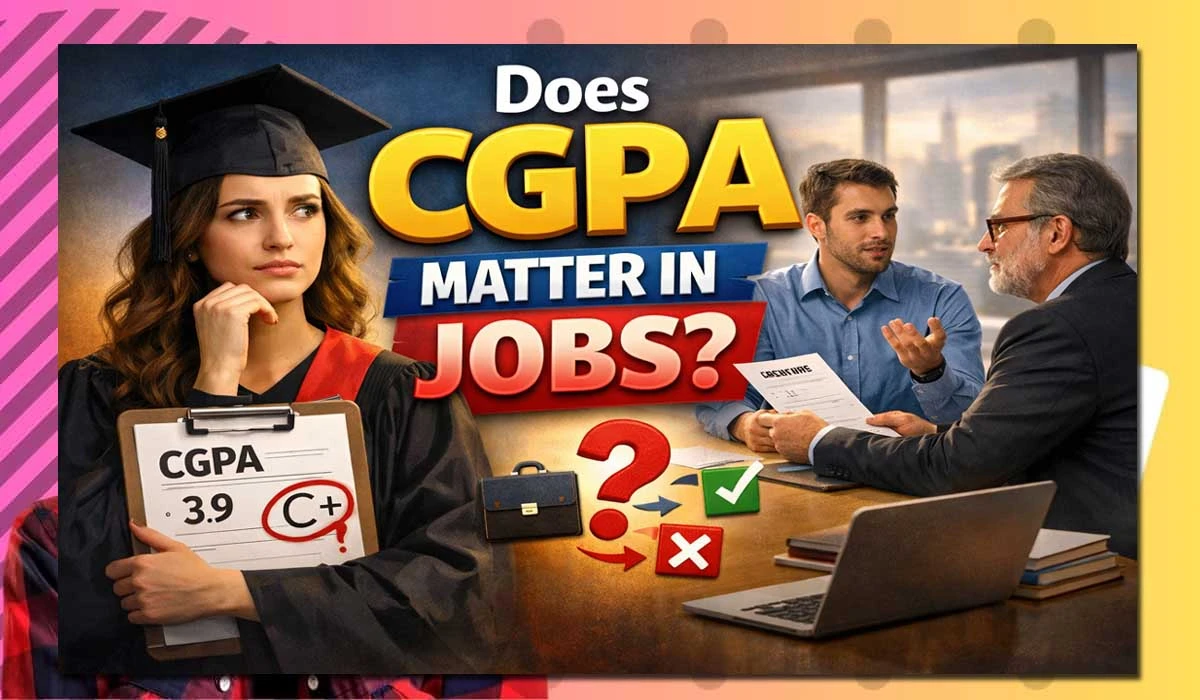
So you just checked your semester results and your CGPA is not what you hoped for. Now you’re sitting there thinking — “Will I even get a job with this?”
Trust me, you’re not alone. Thousands of students ask this every single year.
Here’s the honest truth — CGPA does matter, but not always, and not as much as your college probably told you. It depends a lot on what kind of job you’re going for and what stage of your career you’re at.
Let’s break this down simply. No complicated stuff, no panic — just a clear picture of where CGPA actually counts and where it really doesn’t.
What is CGPA and Why is It Important?
CGPA stands for Cumulative Grade Point Average. In simple words, it’s a number that shows how well you performed across all your semesters put together.
Think of it like your report card — but for your entire college life.
Now, why do companies even look at it?
- It shows your consistency in studies over the years
- Recruiters get hundreds of applications, so they use CGPA to filter candidates quickly
- Many companies set a minimum cutoff just to keep the list manageable
So yes, CGPA is like your first impression on paper. But here’s the thing — a first impression is not the whole story. You can still get the job even if that number isn’t great. Let’s see how.
Does CGPA Matter in Government Jobs?
Short answer — not really.
Government jobs work very differently. Whether it’s SSC, UPSC, or any state-level exam, selection depends almost entirely on how well you perform in the exam. Your CGPA might be needed just to prove you’re eligible — like, you have the basic degree. That’s it.
A student with 9 CGPA and a student with 6 CGPA have almost the same shot at a government job if they both clear the exam.
So if you’re aiming for government jobs — stop stressing about CGPA and start studying for the exam. That’s where your energy should go.
Does CGPA Matter in Private Jobs?
Here, the answer is a little more nuanced.
Private companies — especially big ones hiring freshers — do care about CGPA. Many of them set a cutoff like 6.5 or 7 CGPA. If you’re below that, your resume might not even get opened.
This matters most during campus placements. That’s when recruiters come to your college and they’re meeting 200 students in a day. They need some way to shortlist people fast. CGPA becomes that filter.
But here’s the good news — once you have 2 or 3 years of work experience, almost no one asks about your CGPA. At that point, your work speaks louder.
So CGPA helps you get your foot in the door. After that, it’s all about you.
Does CGPA Matter in the IT Industry?
Yes, but only at the start.
Companies like TCS, Infosys, Wipro — they often ask for a minimum of 60% or 65% marks (which roughly means around 6–6.5 CGPA). It’s part of their standard hiring process for fresh graduates.
But you know what’s funny? Once you’re in — nobody cares. Your coding skills, your ability to solve problems, how fast you learn — that’s what matters in the IT world.
And if you’re looking at startups? Most of them don’t even ask about CGPA. They want to see your GitHub profile, your projects, your thinking ability.
Skills beat CGPA in the long run. Every single time.
Does CGPA Matter in Off-Campus Placements?
Off-campus hiring is a whole different game.
When you apply directly to a company — through LinkedIn, job portals, or referrals — the recruiter is looking at your actual skills. They want to know: Can you do the job? Do you have projects? Have you done internships?
Your CGPA might be on your resume, but it’s rarely the deciding factor here. A strong portfolio with real work will always do more than a good GPA.
Networking also plays a big role. Sometimes it’s not what you know — it’s who knows you. Getting a referral from someone inside the company can open doors that CGPA never could.
Minimum CGPA Required for Jobs — Reality Check
Let’s be real about the numbers:
| CGPA Range | What It Means |
| 8+ CGPA | Best shot at top companies and campus placements |
| 7–8 CGPA | Good options, most companies will consider you |
| 6–7 CGPA | Average — still manageable with good skills |
| Below 6 CGPA | Harder path, but absolutely possible with the right skills |
You might be thinking — “I’m below 6, so I have no chance.” That’s not true. It just means you need to work a little harder on building skills and experience. Many successful professionals had low GPAs. What they had was hustle.
CGPA vs Skills — What Do Employers Really Prefer?
Let me ask you something. If you were hiring someone for your team, what would you prefer — a person who scored 9 CGPA but can’t communicate well, or someone with 6.5 CGPA who can solve problems, work in a team, and get things done?
Most employers today are going with the second option.
What they actually look for:
- Practical skills — Can you do the actual work?
- Communication — Can you explain your ideas clearly?
- Problem-solving — How do you handle challenges?
- Real projects — Have you actually built something?
CGPA helps you get shortlisted. But skills get you hired. Remember that difference.
How to Get a Job with Low CGPA
Okay so your CGPA isn’t great. That’s fine. Here’s what you can do right now:
1. Learn a high-demand skill Coding, digital marketing, data analysis, UI/UX design — pick one and go deep. These skills have great job demand and employers love them.
2. Do internships Even unpaid ones. Real experience beats classroom knowledge every time.
3. Build a portfolio Create projects. Put them on GitHub or a personal website. Show employers what you can actually do.
4. Work on your resume A well-written resume with strong skill sections can easily outshine a high CGPA. Get it reviewed.
5. Use LinkedIn properly Connect with people in your industry. Engage with their posts. Reach out professionally. Opportunities come through people, not just job portals.
Final Verdict: Does CGPA Really Matter in Jobs?
Let’s wrap this up simply:
| Job Type | Does CGPA Matter? |
| Government Jobs | ❌ Yes, moderately |
| Private Jobs (Fresher) | ⚠️ Yes, moderately |
| IT Industry | ⚠️ Only at entry level |
| Off-Campus Hiring | ❌ Mostly no |
The honest answer? CGPA matters at the beginning — but it’s not the end of your story.
If your CGPA is high, great — use it as an advantage early on. If it’s not, stop beating yourself up and start building skills instead. The job market today cares a lot more about what you can do than what you scored in exams.
Your degree gets you in the room. Your skills and attitude keep you there.
So go build something, learn something, and stop worrying about that number. You’ve got this. 💪