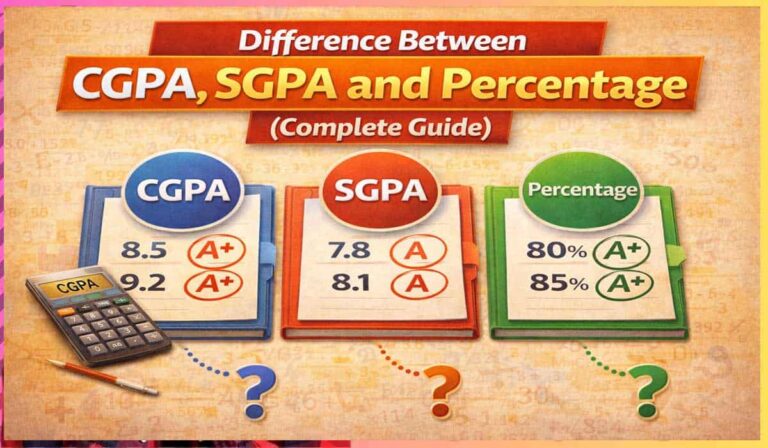
CGPA to Percentage Formula – Complete Guide for All Indian Universities & Boards

Every student now a days want to know CGPA to Percentage Formula becouse when student received result they find CGPA instead of percentage on the marksheet. Then comes the real problem — at the time of filling a job form, a scholarship portal, or a university admission page asks for a percentage, not CGPA.
I have seen students panic over this, multiply their CGPA by the wrong number, and submit an incorrect score on an official form. The truth is there is no single CGPA to percentage formula that works for every institution in India. CBSE uses one method. Anna University uses another. Delhi University and KTU follow their own rules too.
This guide gives you the exact formula for your board or university, with real examples, so you never have to guess again.
If you want to calculate your CGPA to Percentage using our online tool, use the below tool it will calculate cgpa, sgpa and percentage easily and instantly.
Free CGPA, SGPA and Percentage Calculators for Indian Students
All calculators use official university formulas — select your university and get instant results.
CGPA to Percentage Calculator
Convert your semester CGPA to percentage using your university’s official formula. Supports VTU, Anna University, AKTU and 50+ more.
Calculate Now →SGPA to Percentage Calculator
Convert your semester SGPA to percentage using your university’s official formula. Supports VTU, Anna University, AKTU and 50+ more.
Calculate Now →Percentage to CGPA Calculator
Convert your percentage back to CGPA instantly. Works for all Indian universities on both 10-point and 4-point grading scales.
Calculate Now →SGPA to CGPA Calculator
Calculate your overall CGPA from multiple semester SGPAs. Add each semester’s SGPA and credits for an accurate cumulative result.
Calculate Now →What is CGPA, SGPA and Percentage
CGPA stands for Cumulative Grade Point Average. It is a single number, usually between 0 and 10, that sums up your performance across all semesters or subjects.
SGPA is the same idea, but for just one semester. Once you finish multiple semesters, your CGPA becomes the credit-weighted average of all your SGPA scores.
Percentage, on the other hand, is the old, familiar number out of 100. Most parents understand the percentage. Banks, embassies, and many employers still ask for it. That gap between the grading system colleges use and the number everyone else expects is exactly why this conversion exists.
Here’s something worth knowing: CGPA and percentage are not mathematically interchangeable. A formula gives you an approximate, university-accepted equivalent — not your literal average marks.
CGPA to Percentage Formula (10 Point Scale)
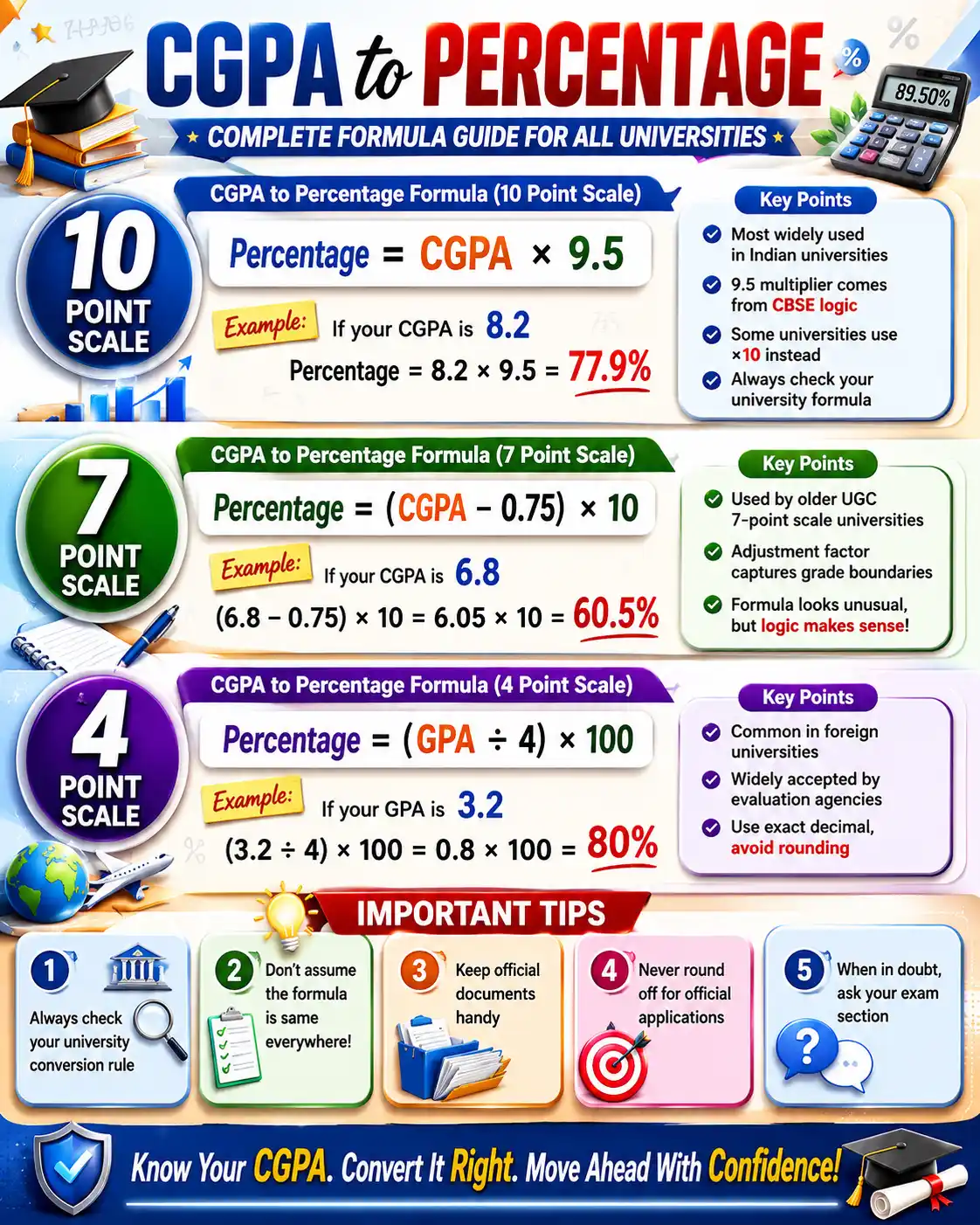
Most Indian universities run on a 10-point scale, and the most widely used formula is:
Percentage = CGPA × 9.5
So if your CGPA is 8.2, your percentage works out to 8.2 × 9.5 = 77.9%.
This 9.5 multiplier comes from the Central Board of Secondary Education‘s own logic, and it has been copied by colleges across the country because it’s simple. But — and this is where most students go wrong — not every 10-point university actually uses 9.5. Several use a flat ×10 instead. Always check your specific formula before writing a percentage on any form.
CGPA to Percentage Formula (7 Point Scale)
A smaller group of universities, especially those following older University Grants Commission choice-based credit systems, use a 7-point scale. The common formula here is:
Percentage = (CGPA − 0.75) × 10
Take a CGPA of 6.8 on this scale. Subtract 0.75 and you get 6.05. Multiply by 10, and your percentage is 60.5%.
This formula looks odd the first time you see it, but the logic makes sense — it adjusts for grade boundaries that don’t line up the same way as a 10-point scale.
CGPA to Percentage Formula (4 Point Scale)
If you’ve studied abroad, transferred credits, or you’re applying to a foreign university, you’ll run into the 4-point GPA scale. The conversion most evaluators accept is:
Percentage = (GPA ÷ 4) × 100
A GPA of 3.2 becomes (3.2 ÷ 4) × 100 = 80%.
A quick tip from experience: when filling abroad application forms, never round this number yourself. Agencies like World Education Services (WES) and most embassies want the exact decimal, not your rounded-off version.
University-Wise CGPA to Percentage Formula
Formulas change from one university to another, sometimes for historical reasons, sometimes because of a specific academic council decision. Here’s a quick reference for the most searched Indian universities. Treat these as a starting point — your official marksheet circular always has the final word.
Anna University CGPA to Percentage Formula
Most official sources point to a flat Percentage = CGPA × 10 — a CGPA of 8.0 simply becomes 80%. A smaller number of sources cite (CGPA − 0.75) × 10 instead, which would make the same 8.0 CGPA equal 72.5%. The two figures don’t match, so confirm against your own consolidated marksheet or Anna University‘s examination branch before quoting either one on a form.
VTU (Visvesvaraya Technological University) CGPA to Percentage Formula
VTU follows the same flat formula: Percentage = CGPA × 10. A 7.5 CGPA becomes 75%.
Mumbai University CGPA to Percentage Formula
For engineering programmes, Mumbai University uses Percentage = 7.25 × CGPA + 11. For other UG streams such as Arts, Commerce, and Pure Sciences, many affiliated colleges apply the general UGC-style Percentage = (CGPA − 0.75) × 10, though this isn’t confirmed as a Mumbai-specific circular — treat it as a starting estimate and confirm with your college before relying on it.
Delhi University CGPA to Percentage Formula
Delhi University officially adopted Percentage = CGPA × 9.5 through a 2018 examination circular, applicable across most undergraduate programmes.
KTU (APJ Abdul Kalam Technological University) CGPA to Percentage Formula
KTU revised its rule in 2023. The current official rule is Percentage = CGPA × 10, replacing an older method that subtracted 2.5 before multiplying.
MAKAUT (WBUT) CGPA to Percentage Formula
Runs on a 7-point scale. Sources differ on the exact formula — some cite Percentage = (CGPA − 0.75) × 10, others describe a flat ×10 method similar to VTU. These may even refer to two differently-named institutions that share “Maulana Abdul Kalam Azad” in their title, so confirm the formula on your own grade sheet rather than this guide.
AKTU (Dr. APJ Abdul Kalam Technical University) CGPA to Percentage Formula
Uses Percentage = (CGPA − 0.5) × 10. A CGPA of 7.6 gives you 71%.
JNTU Hyderabad / Kakinada / Anantapur CGPA to Percentage Formula
All three campuses generally apply Percentage = CGPA × 10 for B.Tech programmes.
Osmania University CGPA to Percentage Formula
Most secondary sources group it under the flat Percentage = CGPA × 10 method, but this isn’t confirmed from an official Osmania circular — verify with your affiliated college before quoting it.
Savitribai Phule Pune University (SPPU) CGPA to Percentage Formula
Most secondary sources cite Percentage = CGPA × 10 across engineering and technology courses, though this hasn’t been confirmed from an official SPPU notification — check your specific college’s circular.
Bangalore University CGPA to Percentage Formula
Often grouped with the flat Percentage = CGPA × 10 method in secondary sources, but I couldn’t confirm this from an official Bangalore University circular. Some affiliated colleges use their own internal scale — check your specific college circular.
Calcutta University CGPA to Percentage Formula
Often assumed to follow the UGC pattern, Percentage = CGPA × 9.5, but I couldn’t confirm this from an official Calcutta University source — this is an inference, not a verified circular. Confirm with your department before using it.
Gujarat Technological University (GTU) CGPA to Percentage Formula
Does not follow one fixed multiplier across every batch. Formulas have changed by academic year, so check your specific year’s official GTU notification.
Rajasthan Technical University (RTU) CGPA to Percentage Formula
Cited in secondary sources as Percentage = CGPA × 10, but not confirmed from an official RTU notification — verify before using it on a form.
RGPV (Rajiv Gandhi Proudyogiki Vishwavidyalaya) CGPA to Percentage Formula
Cited in secondary sources as Percentage = CGPA × 10, similar to many other AICTE-affiliated technical universities, but not confirmed from an official RGPV notification — verify before relying on it.
Punjab Technical University (PTU) CGPA to Percentage Formula
Cited in secondary sources as Percentage = CGPA × 10, but not confirmed from an official PTU/IKGPTU notification — verify with your college before using it.
GGSIPU (Guru Gobind Singh Indraprastha University) CGPA to Percentage Formula
Cited in secondary sources as Percentage = CGPA × 10, but not confirmed from an official GGSIPU notification — check with your affiliated institute first.
BPUT (Biju Patnaik University of Technology) CGPA to Percentage Formula
Uses an offset-based formula that has varied by scheme year. Confirm the exact figure from your official BPUT notification rather than assume a fixed multiplier.
Banaras Hindu University (BHU) CGPA to Percentage Formula
Often assumed to follow the UGC-style Percentage = CGPA × 9.5, common across many central universities — but I couldn’t confirm this specifically for BHU from an official source. One lower-reliability source even suggests BHU treats CGPA as numerically equal to percentage. Confirm with the exam section directly.
Jawaharlal Nehru University (JNU) CGPA to Percentage Formula
Often assumed to follow the same ×9.5 central-university pattern, but this isn’t independently confirmed for JNU specifically. Confirm with JNU’s examination branch before using it on a form.
Jadavpur University CGPA to Percentage Formula
Does not publish one universal multiplier for every department. Your department’s examination cell is the most reliable source for an official conversion.
Calicut University CGPA to Percentage Formula
For B.Tech (2009 scheme), Calicut University uses a tiered formula rather than one flat multiplier: for an equivalent percentage between 40–90%, Percentage = 40 + (CGPA − 0.5) × 10; for the 90–100% band, Percentage = 90 + (CGPA − 5.5) × 20. Other programmes or schemes may use a simpler flat multiplier — check your specific scheme year before applying either formula.
Andhra University CGPA to Percentage Formula
Often assumed to follow the common UGC formula, Percentage = CGPA × 9.5, but this hasn’t been confirmed from an official Andhra University source — treat it as a starting estimate only.
IIT (Bombay, Delhi, Kanpur and most others) CGPA to Percentage Formula
Most IITs treat CGPA on a 10-point scale as directly equivalent to percentage, so Percentage = CGPA × 10. An 8.4 CGPA reads as 84%. One source specifically flags IIT Madras as an exception that uses ×9.5 instead — I couldn’t independently confirm this, so if you’re an IIT Madras student, verify with your academic section rather than assuming the ×10 figure applies to you.
NIT System CGPA to Percentage Formula
NITs don’t share one common rule. Each campus sets its own policy, so your specific institute’s academic section or official transcript is the only dependable source.
Gauhati University CGPA to Percentage Formula
Gauhati University standardised its rule through an official 2020 notification: Percentage = CGPA × 10, applicable to all batches from 2008 onward. An 8.5 CGPA equals 85%.
Cotton University CGPA to Percentage Formula
Cotton University‘s Executive Council approved Percentage = CGPA × 10 in April 2022, applied retrospectively to all UG and PG examinations, including those issued under the earlier Cotton College State University name. Any older formula printed on a grade sheet should be ignored in favour of this one.
Dibrugarh University CGPA to Percentage Formula
A current student grade report from Dibrugarh University (session 2024–25) shows the formula stated as Percentage = CGPA × 10. An older 2021 notification used a different tiered formula for specific CGPA ranges, so if you graduated before that change, cross-check the formula printed on your own grade sheet rather than assuming ×10 retroactively.
Tezpur University CGPA to Percentage Formula
Tezpur University, a central university, maintains its own official conversion formula document through its academic regulations page. Most cited versions use a 10-point multiplier, though some sources reference (CGPA − 0.75) × 10. Given the conflicting citations online, this is one to verify directly with the examination branch before submitting any official form.
CBSE CGPA to Percentage Formula (Class 10 & 12)
CBSE Class 10 results are still issued as grades and CGPA, not a printed percentage. Your CGPA comes from the grade points of your five main subjects — add them up and divide by 5.
To get an approximate percentage, multiply that CGPA by 9.5. A student with a CGPA of 9.4 gets roughly 89.3%.
For Class 12, CBSE shows your actual subject-wise marks, so there’s usually nothing to convert — except when a college specifically asks for a CGPA-based aggregate, where the same ×9.5 rule applies.
Worth flagging: this 9.5 figure is an approximate, accepted number, not your literal exam score. CBSE itself calls it indicative, so don’t be surprised if a college’s internal eligibility calculation looks slightly different.
How to Calculate CGPA to Percentage (With Example)
Let’s walk through a full example, the way I’d explain it to a student sitting across from me.
Suppose you’ve completed four semesters with these SGPA scores: 7.8, 8.0, 8.2, and 7.6.
Step 1: Add them. 7.8 + 8.0 + 8.2 + 7.6 = 31.6 Step 2: Divide by the number of semesters. 31.6 ÷ 4 = 7.9 — that’s your CGPA. Step 3: Apply your university’s formula. With a CBSE-style 9.5 formula, 7.9 × 9.5 = 75.05%.
If your university instead uses the flat ×10 method, the same 7.9 CGPA becomes 79%. Same student, same marks, a four-point difference — purely because of which formula applies. This is exactly why checking your university’s specific rule matters more than memorising one universal number.
CGPA to Percentage Conversion Chart
Use this as a quick lookup. Always confirm which column applies to your institution.
| CGPA | Percentage (× 9.5) | Percentage (× 10) |
| 6.0 | 57.00% | 60.00% |
| 6.5 | 61.75% | 65.00% |
| 7.0 | 66.50% | 70.00% |
| 7.5 | 71.25% | 75.00% |
| 8.0 | 76.00% | 80.00% |
| 8.5 | 80.75% | 85.00% |
| 9.0 | 85.50% | 90.00% |
| 9.5 | 90.25% | 95.00% |
| 10.0 | 95.00% | 100.00% |
Notice the gap widens as CGPA increases. At 6.0, the difference is just 3%. At 10.0, it’s a full 5%. That gap is precisely why a topper from one university can show a lower percentage than an average student from another, purely on paper.
Percentage to CGPA Formula (Reverse Conversion)
Sometimes the question runs the other way — a form asks for CGPA, but all you have is a percentage from an earlier qualification. The common reverse formula on a 10-point scale is:
CGPA = Percentage ÷ 9.5
So 85% becomes 85 ÷ 9.5 = 8.9 CGPA, approximately.
Keep in mind this works only as an estimate. Your actual CGPA depends on individual subject grade points, not just your overall percentage, so use this for rough planning, not official certificates.
SGPA to Percentage Formula
SGPA follows the same logic as CGPA, just for a single semester. If your university uses the 9.5 formula for CGPA, it generally applies the same multiplier to SGPA.
Percentage (per semester) = SGPA × 9.5
A semester SGPA of 8.3 converts to 8.3 × 9.5 = 78.85% for that term. Some scholarship and hostel-renewal forms specifically ask for semester-wise percentage, so this calculation comes up more often than students expect.
Why CGPA to Percentage Conversion is Important
Colleges adopted CGPA to reduce the obsession with exact marks and reward consistent learning over one-off exam performance. That’s a reasonable goal. But the rest of the world hasn’t fully caught up.
Government job applications, several PSU recruitment forms, study-abroad portals, and even some private-sector HR systems still ask for a percentage figure. Without a conversion, you simply can’t fill those forms correctly.
A practical example: I’ve seen engineering graduates get their applications rejected at the screening stage because they entered their CGPA in a field meant for percentage, without converting it first. The number looked too low, and the system flagged it automatically. A two-minute calculation would have avoided that entirely.
FAQs on CGPA to Percentage Formula
1. What is the formula to convert CGPA to percentage?
For most Indian universities on a 10-point scale, Percentage = CGPA × 9.5. Some universities, including Anna University, VTU, and KTU, use Percentage = CGPA × 10 instead. There’s no single formula for the entire country — your university’s official notification decides which one applies to you.
2. How do you calculate percentage from CGPA out of 10?
Multiply your CGPA by your university’s official conversion factor, usually 9.5 or 10. A CGPA of 8.0 gives 76% with the 9.5 method, or 80% with the ×10 method.
3. Is CGPA multiplied by 9.5 to get percentage?
Yes, for CBSE and several universities following the CBSE-style formula, including Delhi University. But this isn’t universal — many engineering and state technical universities multiply by 10 instead, so confirm before using 9.5 by default.
4. What is the difference between CGPA and percentage?
CGPA is a grade-based average, usually out of 10, reflecting overall academic performance across subjects or semesters. Percentage is a marks-based score out of 100. They measure similar things but are calculated differently, which is why a formula is needed to move between them.
5. How to convert SGPA to percentage?
Use the same formula your university applies to CGPA. Multiply your SGPA by 9.5 or 10, depending on your institution’s official rule, to get your percentage for that semester.
Conclusion
At this point, you have what most students spend hours searching for — the right formula for your specific board or university, not a generic number that may not apply to you.
If there’s one thing to remember from this guide, it’s this: never assume. CGPA-to-percentage rules differ enough between universities that the same score can mean a four or five percent difference depending on which formula applies. Pull up your official notification, marksheet circular, or examination cell document, confirm your university’s exact multiplier, and use it consistently across every application you submit.
Once you know your formula, the calculation itself takes ten seconds. Bookmark this guide, and you’ll never have to second-guess a percentage figure again.