
SGPA to CGPA Calculator
Every semester adds to your overall CGPA — but the calculation is not a simple average, credits matter too. Enter your SGPA and credit hours semester-wise above and get your accurate cumulative CGPA instantly.
Select Grading Scale
Enter Semester SGPA & Credits
Semester Breakdown
| Semester | SGPA | Credits | Weighted Points |
|---|
Accuracy
The CGPA to Percent calculator is designed with modern technology, accurate logic and formulas.
Responsive
This online calculator tool is user-friendly and responsive on any mobile, web or tablet device.
Fast
It has implemented fast loading and quick calculation technology. So you will get your output within a second.
SGPA to CGPA Calculator: Easy SGPA to CGPA Conversion with Formula
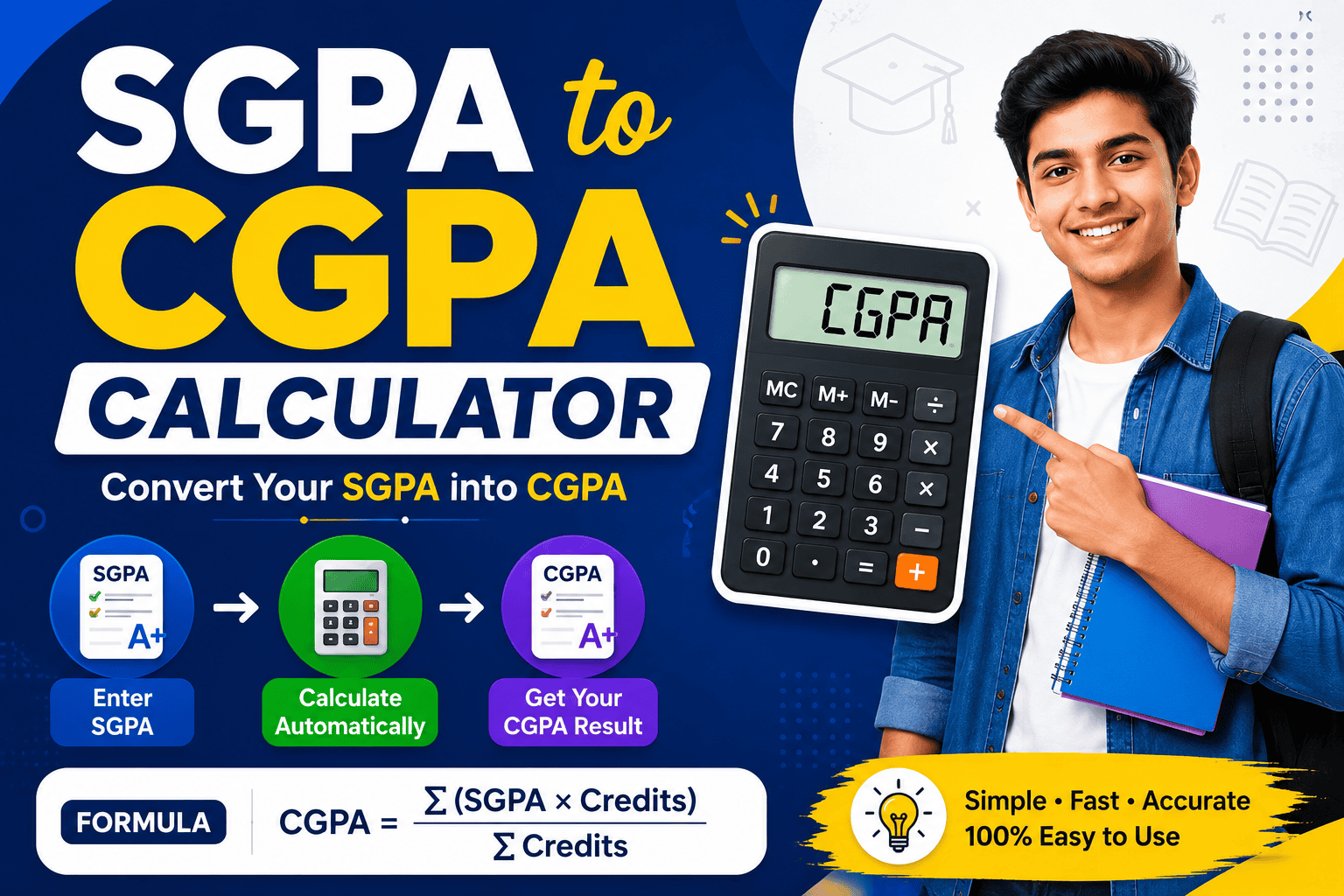
I often see students getting confused when they receive their semester results. They see terms like SGPA, CGPA, grade points, and credits, but they are not always sure what those numbers actually mean.
One of the most common questions students ask is, “How do I convert SGPA to CGPA?” The answer depends on your university’s grading system, but once you understand the basics, the process becomes much easier.
A good SGPA to CGPA calculator helps you calculate your overall academic score without spending time on manual calculations. It is useful for engineering students, university students, scholarship applicants, and anyone who wants to track academic performance.
In this guide, I’ll explain SGPA, CGPA, their differences, conversion methods, and the formulas used in many universities. I’ll also point out a few common mistakes that students make when calculating their CGPA.
What is SGPA?
SGPA is one of the most commonly used grading terms in colleges and universities.
It tells you how well you performed during a single semester. Instead of looking at marks from each subject separately, SGPA combines all subject grades into one score.
This gives students a quick overview of their semester performance.
SGPA Full Form
SGPA stands for Semester Grade Point Average.
As the name suggests, it measures your academic performance for one semester only.
Universities calculate SGPA using:
- Subject grades
- Grade points
- Credit points
The exact calculation method may vary slightly between universities, but the overall concept remains the same.
How Semester Grade Point Average Works
Let’s look at a simple example.
Suppose you studied five subjects during a semester.
Each subject has:
- A grade point
- A credit value
The university multiplies the grade point of each subject by its credit value.
Then all the values are added together.
Finally, the total is divided by the total number of credits.
The result is your SGPA.
One common mistake I see students make is assuming SGPA is based only on marks. In reality, credits also play an important role in many university grading systems.
Importance of SGPA in Academic Performance
SGPA helps students understand how they performed during a specific semester.
A good SGPA can help with:
- Scholarships
- Academic awards
- Internship applications
- Semester performance tracking
- Higher education opportunities
Think of SGPA as a snapshot of your performance during a particular semester.
If one semester doesn’t go well, don’t panic. Most universities calculate CGPA using multiple semesters, so future improvements can help raise your overall score.
What is CGPA?
While SGPA measures one semester, CGPA looks at your performance across your entire course.
This is usually the number students focus on most because it reflects long-term academic consistency.
Different universities may follow different grading systems. Students should always check their university’s official academic regulations before calculating CGPA.
CGPA Full Form
CGPA stands for Cumulative Grade Point Average.
It represents your overall academic performance across all completed semesters.
Unlike SGPA, which changes every semester, CGPA grows throughout your degree program.
Understanding Cumulative Grade Point Average
Let’s look at a practical example.
Suppose your semester results are:
- Semester 1 = 8.0
- Semester 2 = 8.4
- Semester 3 = 8.7
- Semester 4 = 8.2
Your CGPA combines all these semester scores into a single cumulative score.
This gives a more balanced view of your academic performance than a single semester result.
I often tell students that one bad semester rarely defines their academic future. CGPA rewards consistent performance over time.
Why CGPA Matters in Higher Education
CGPA is important because many organizations use it as a screening factor.
For example:
- University admissions
- Postgraduate programs
- Scholarships
- Campus placements
- Competitive applications
Employers and universities often prefer looking at a student’s overall performance rather than a single semester.
That is why maintaining a healthy CGPA throughout your course can be beneficial.
SGPA vs CGPA: Understanding the Difference
Students frequently confuse SGPA and CGPA because both are based on grade points.
However, they measure different things.
SGPA and CGPA Difference Explained
The simplest way to remember the difference is:
SGPA = One Semester
CGPA = All Semesters Combined
SGPA helps you understand how you performed during a specific semester.
CGPA helps you understand how you performed throughout your course.
Semester Result vs Overall Academic Score
SGPA focuses on:
- One semester
- Current academic performance
- Recent grades
CGPA focuses on:
- Multiple semesters
- Overall academic score
- Long-term consistency
Imagine a student scores a lower SGPA in the first semester but improves steadily later.
The final CGPA may still be quite strong because it reflects cumulative performance.
When Universities Use SGPA and CGPA
Universities use SGPA when:
- Publishing semester results
- Reviewing current semester performance
Universities use CGPA when:
- Issuing final transcripts
- Awarding degrees
- Evaluating graduation requirements
- Processing higher education applications
Understanding this difference helps students avoid confusion when reviewing their academic records.
SGPA to CGPA Calculator
An SGPA to CGPA calculator is one of the easiest tools students can use.
Instead of manually calculating grades across multiple semesters, you simply enter your semester scores and receive an estimated CGPA.
How the SGPA to CGPA Calculator Works
Most calculators require:
- Semester-wise SGPA
- Number of semesters
- Credit details (if applicable)
After entering the data, the calculator processes the information and displays your estimated CGPA.
The exact calculation may vary depending on whether your university uses simple averaging or credit-weighted calculations.
Benefits of Using an Online SGPA to CGPA Converter
Many students prefer using online calculators because they make calculations much easier.
Faster Results
Manual calculations can take time, especially when multiple semesters are involved.
A calculator generates results within seconds.
Fewer Mistakes
Even small calculation errors can affect your final result.
A calculator helps reduce the risk of mistakes.
Better Academic Tracking
Students can monitor their progress after every semester.
This makes it easier to set realistic academic goals.
Helpful for Future Planning
Knowing your CGPA helps you understand what scores you may need in future semesters to reach your target.
SGPA to CGPA Calculator for Engineering Students
Engineering students often deal with:
- Multiple semesters
- Laboratory subjects
- Project credits
- Elective subjects
- Different credit structures
Because of this, manual calculations can become complicated.
A dedicated SGPA to CGPA calculator for engineering students simplifies the process by handling multiple semesters and credit-based calculations.
If you’ve ever tried calculating CGPA across six or eight engineering semesters manually, you’ll understand why these calculators are so popular.
How to Convert SGPA to CGPA
Many students prefer understanding the calculation process rather than relying entirely on a calculator.
That is a good habit because it helps verify results.
SGPA to CGPA Conversion Formula
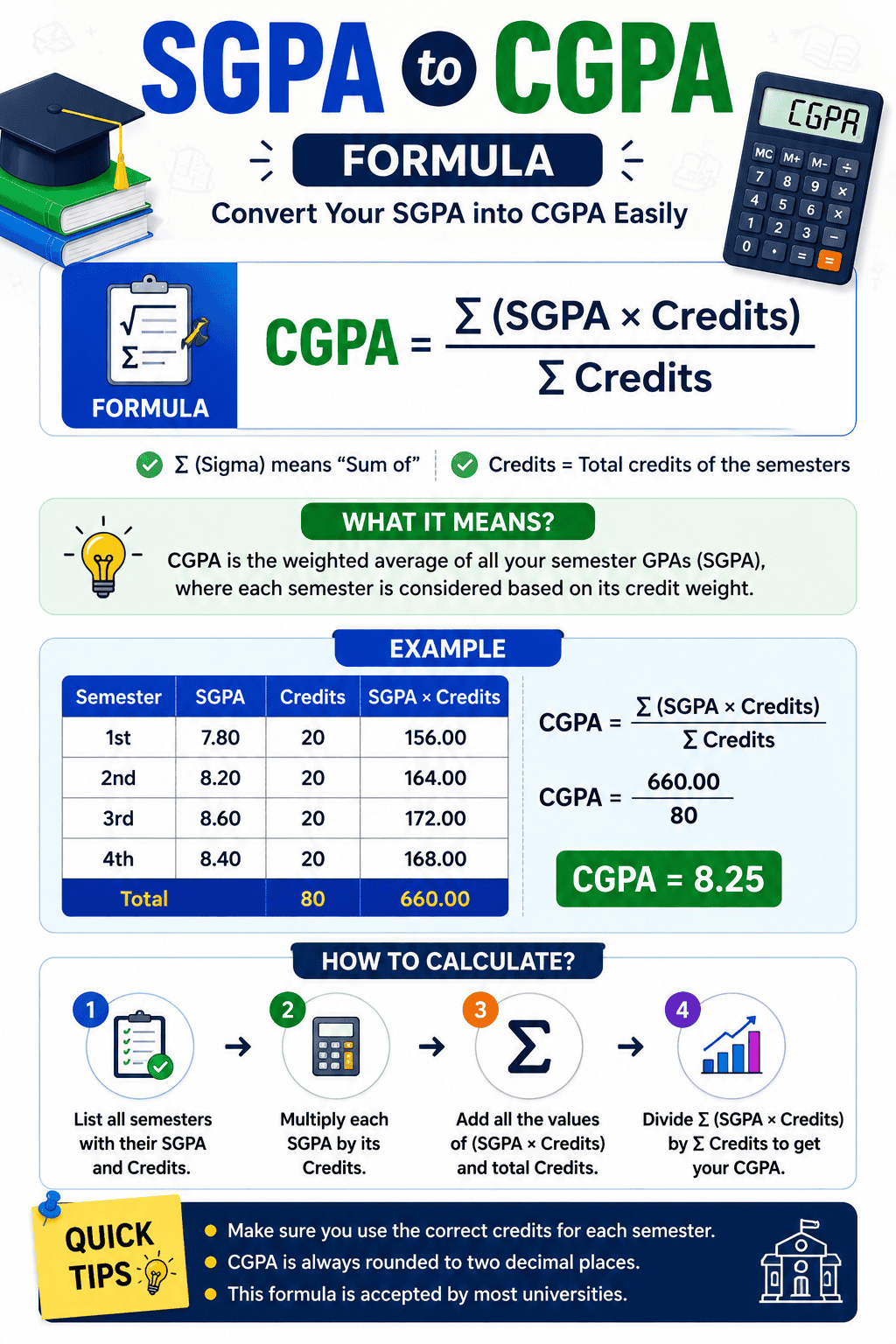
One commonly used formula is:
CGPA = Sum of All Semester SGPAs ÷ Number of Semesters
However, there is an important point many students miss.
This formula works only when all semesters carry equal weight.
Some universities use a credit-weighted system instead.
That means semesters with higher total credits may contribute more to the final CGPA.
Always check your university’s official grading policy before using any formula.
Step-by-Step SGPA and CGPA Conversion
Let’s look at a simple example.
Suppose your semester SGPAs are:
- Semester 1 = 8.0
- Semester 2 = 8.5
- Semester 3 = 7.5
- Semester 4 = 9.0
Step 1
Add all SGPAs.
8.0 + 8.5 + 7.5 + 9.0 = 33
Step 2
Divide by the number of semesters.
33 ÷ 4 = 8.25
Your CGPA is 8.25.
This method works well when semesters are weighted equally.
Calculate CGPA Using SGPA Marks
You can calculate CGPA manually or use an online CGPA conversion calculator.
For a few semesters, manual calculations are manageable.
Once multiple semesters, varying credits, projects, and practical subjects are involved, most students find calculators more convenient and accurate.
SGPA to CGPA Formula Explained
Many students use an SGPA to CGPA calculator without understanding the actual formula behind it.
That usually isn’t a problem until the calculator gives an unexpected result.
Understanding the logic behind the calculation helps you verify results and identify mistakes.
It also helps when universities use different grading systems or credit structures.
SGPA to CGPA Formula Explained
CGPA Calculation Formula:
The exact CGPA calculation method depends on your university. This is something many students overlook.
Some universities calculate CGPA using a simple average of semester SGPAs. Others use a credit-weighted formula where subjects and semesters with higher credits have more influence on the final result.
A commonly used formula is:
CGPA = Total Grade Points Earned ÷ Total Credit Points
This method is usually considered more accurate because it takes subject credits into account.
Grade Point and Credit Point Calculation
To understand CGPA properly, you need to know two basic terms.
Grade Points:
Grade points represent your performance in a subject.
For example:
- O Grade = 10 Points
- A+ Grade = 9 Points
- A Grade = 8 Points
- B+ Grade = 7 Points
Different universities may use slightly different grading scales, so always refer to your institution’s official grading system.
Credit Points:
Credits show the importance or weight of a subject.
For example:
- Mathematics = 5 Credits
- Physics = 4 Credits
- English = 2 Credits
A subject with higher credits affects your CGPA more than a subject with fewer credits.
One common mistake I see students make is focusing only on grades while ignoring credit values. In many universities, credits matter just as much as grades.
Semester-wise CGPA Calculation Method
Let’s look at a simple example.
| Semester | SGPA |
| Semester 1 | 8.0 |
| Semester 2 | 8.5 |
| Semester 3 | 7.8 |
| Semester 4 | 8.7 |
Total SGPA = 33.0
CGPA = 33.0 ÷ 4
CGPA = 8.25
This example assumes all semesters have equal weight. If your university uses credit-weighted calculations, the final result may differ slightly.
SGPA to CGPA Percentage Conversion
Many students need percentage values for scholarships, job applications, admissions, or competitive exams.
If you only want to convert your semester SGPA directly into percentage, you can use our SGPA to Percentage Calculator for a quick and accurate calculation based on your university’s grading system.
This is where SGPA to CGPA percentage conversion becomes useful.
However, there is an important point to remember.
There is no universal SGPA-to-percentage formula that works for every university.
Always verify the official conversion method used by your institution.
How to Convert SGPA to CGPA Percentage
Some universities use a multiplier such as:
Percentage = CGPA × 9.5
For example:
CGPA = 8.0
Percentage = 8.0 × 9.5
Percentage = 76%
But please don’t assume this formula applies everywhere.
Many universities use:
- Different multipliers
- Different grading scales
- Custom percentage conversion methods
Always check your university’s official guidelines before using any formula.
SGPA to CGPA to Percentage Calculator
A SGPA to CGPA to percentage calculator performs multiple calculations in one place.
It can:
- Convert SGPA into CGPA
- Convert CGPA into percentage
- Save time
- Reduce manual errors
Students preparing applications often find these calculators particularly helpful because many forms ask for percentage rather than CGPA.
If you already know your CGPA and only need a percentage conversion, try our CGPA to Percentage Calculator. It provides a faster way to convert your CGPA into percentage without calculating SGPA and CGPA again.
SGPA Percentage Calculator vs CGPA Percentage Calculator
Students often confuse these two tools.
SGPA Percentage Calculator
Used for:
- One semester
- Semester result analysis
- Short-term academic performance
CGPA Percentage Calculator
Used for:
- Entire degree performance
- Overall academic score
- Final academic evaluation
Both tools serve different purposes, so choose the one that matches your needs.
Multiple Semester SGPA to CGPA Calculator
As the number of semesters increases, calculations become more complicated.
This is where a multiple semester SGPA to CGPA calculator becomes useful.
Instead of calculating each semester separately, the calculator combines all semester results automatically.
Overall CGPA Calculation from Multiple Semesters
Suppose your semester SGPAs are:
- Semester 1 = 8.2
- Semester 2 = 8.5
- Semester 3 = 7.9
- Semester 4 = 8.8
- Semester 5 = 8.4
- Semester 6 = 8.7
Total = 50.5
CGPA = 50.5 ÷ 6
CGPA = 8.42
This gives you a quick estimate of your overall academic score.
Cumulative CGPA Calculator from SGPA
A cumulative CGPA calculator from SGPA focuses on your complete academic journey.
It combines:
- Semester grades
- Credit points
- Academic performance across semesters
The result gives a clearer picture of your long-term performance than any single semester score.
Example of Semester Wise CGPA Calculation
Let’s say a student struggled during the first semester.
- Semester 1 = 7.0
Later, performance improved.
- Semester 2 = 8.5
- Semester 3 = 8.8
- Semester 4 = 9.0
Many students worry after one poor semester. From my experience, steady improvement often matters more than a perfect start.
A strong performance in later semesters can significantly improve the final CGPA.
SGPA to CGPA Calculator for Engineering Students
Engineering students often have more complex grading structures than many other courses.
There are:
- Theory subjects
- Lab subjects
- Mini projects
- Major projects
- Internships
- Electives
All these components can affect CGPA calculations.
Engineering CGPA Calculator Guide
An engineering CGPA calculator helps students:
- Convert SGPA to CGPA
- Calculate semester-wise CGPA
- Estimate final percentage
- Track academic performance
Because engineering courses often run for eight semesters, calculators can save considerable time.
Credit-Based CGPA Calculation
Most engineering colleges use a credit-based grading system. Institutes such as IITs and NITs also follow detailed academic regulations that explain how SGPA, CGPA, credits, grading scales, and academic performance are calculated. IIT Madras Academic Ordinances and Regulations
For example:
| Subject | Credits |
| Mathematics | 5 |
| Physics | 4 |
| Programming | 5 |
| Engineering Graphics | 3 |
Higher-credit subjects usually have a greater impact on CGPA.
This is why improving grades in high-credit subjects can sometimes raise your CGPA more effectively than improving low-credit subjects.
Common Engineering University Grading Systems
Many engineering institutions use:
- 10-point grading scale
- Credit-based evaluation
- Semester-wise grading
- Cumulative CGPA system
Examples include:
- IITs
- NITs
- State Technical Universities
- Private Engineering Universities
Although grading rules vary slightly, the basic CGPA concept remains similar.
University Grading Systems and GPA Conversion
One reason students become confused about SGPA and CGPA calculations is that universities do not all follow the same system.
University CGPA Calculator Methods
Different institutions may use:
- Credit-weighted calculations
- Weighted averages
- Direct averaging methods
Because of this, students should always verify the official calculation method used by their university.
College Grading System and University Grading Scale
Common grading systems include:
- 4-point GPA scale
- 5-point GPA scale
- 10-point CGPA scale
The grading scale affects how scores are calculated and interpreted.
Academic Transcript and GPA Conversion
Your academic transcript usually contains:
- Subject grades
- Credit points
- Semester results
- CGPA details
Understanding GPA conversion helps students interpret these records correctly when applying for jobs or higher education opportunities.
Common Mistakes During SGPA to CGPA Conversion
Even good students make mistakes during grade calculations.
Most errors are simple but can lead to incorrect results.
Ignoring Semester Credits
This is probably the most common mistake.
If your university uses credit-based calculations, ignoring credits can produce inaccurate CGPA values.
Always include credit information whenever required.
Using Incorrect Conversion Formula
Students sometimes copy formulas from random websites.
That can create confusion because different universities use different systems.
Always verify the formula through official university guidelines.
Confusing SGPA with CGPA
This happens more often than many students realize.
Remember:
- SGPA = One Semester
- CGPA = Multiple Semesters Combined
Mixing them up can lead to incorrect calculations and misunderstandings.
Tips to Improve Your CGPA
Improving CGPA is usually a gradual process.
Small improvements each semester often create significant results over time.
Academic Performance Tracking
Keep track of:
- Semester grades
- Weak subjects
- Credit-heavy subjects
- Performance trends
Students who monitor their progress regularly often make better academic decisions.
Improving Semester Results
Focus on one semester at a time.
Trying to improve everything at once can feel overwhelming.
A small SGPA improvement each semester can eventually raise your overall CGPA.
Managing Grade Points Effectively
Pay extra attention to subjects with higher credit values.
Improving grades in those subjects often has a bigger impact on your final CGPA.
Simple habits can also help:
- Attend classes regularly
- Submit assignments on time
- Revise consistently
- Practice previous papers
- Ask questions whenever you feel stuck
Frequently Asked Questions (FAQs)
What is SGPA?
SGPA stands for Semester Grade Point Average. It measures academic performance during a single semester.
What is CGPA?
CGPA stands for Cumulative Grade Point Average. It measures overall academic performance across multiple semesters.
How to convert SGPA to CGPA?
In many universities, CGPA is calculated by averaging semester SGPAs. However, some institutions use credit-weighted calculations.
Is SGPA and CGPA the same?
No. SGPA measures one semester, while CGPA measures overall performance across all completed semesters.
How is CGPA calculated from SGPA?
CGPA may be calculated using either a simple average or a credit-weighted formula, depending on university rules.
How many SGPAs are needed to calculate CGPA?
At least two semester SGPAs are generally required, although CGPA becomes more meaningful as more semesters are completed.
What is the formula for SGPA to CGPA conversion?
A commonly used formula is:
CGPA = Sum of Semester SGPAs ÷ Number of Semesters
However, some universities use credit-weighted methods instead.
Can I convert SGPA directly to percentage?
Some universities allow direct conversion, while others require CGPA conversion first. Always check official guidelines.
How to calculate CGPA for engineering students?
Most engineering colleges use credit-based CGPA calculations that consider subject credits and grade points.
Which is more important, SGPA or CGPA?
Both matter. SGPA shows semester performance, while CGPA reflects your overall academic record.
Conclusion
I often tell students not to stress too much about SGPA and CGPA calculations. They can seem complicated at first, especially when different universities use different grading methods.
Once you understand the basics, the calculations become much easier.
A reliable SGPA to CGPA calculator can help you estimate your academic score quickly, but don’t rely on calculators alone. Always check your university’s official grading policy because conversion formulas and credit systems can vary.
One semester rarely defines your academic journey. I’ve seen students recover from low first-semester scores and graduate with excellent CGPAs because they stayed consistent and kept improving.
Track your progress, understand your grading system, and focus on steady improvement. Over time, those small improvements can make a big difference in your final CGPA.