
Percentage To CGPA Converter
Converting percentage to CGPA is not the same for every Indian university — one formula does not fit all. Enter your percentage, pick your university, and get the right CGPA your institution officially recognises.
Select Grading Scale
Quick Reference Table
| Percentage | CGPA | Grade |
|---|
Percentage to CGPA Calculator – The Complete Guide
Percentage to CGPA Conversion is important to know every students. You know that in every sector inlcuding Job, College Admission, Interview they asking for your CGPA while your marksheet only shows a percentage. In that case some students confused how to calculate Precentage to CGPA. You too….Wait.
India’s education system still have percentages syetem in some college and universities. But in the global universities, scholarship portals, and postgraduate programs run on CGPA. Knowing how to calculate percentage to CGPA calculator accurately, and which formula to apply for your specific board or institution, can make a real difference to your academic future.
This guide covers the formula, conversion tables, board-wise rules, worked examples, and the most common mistakes students make everytuing in all details.
Lets Started…
Table of Contents
- Percentage to CGPA Calculator – The Complete Guide
- What Is Percentage?
- What is CGPA?
- Percentage to CGPA Formula
- How to Convert Percentage to CGPA?
- Percentage to CGPA Conversion Table
- Percentage to CGPA Examples
- University Wise Formula
- Common Mistakes
- Percentage vs CGPA
- Conclusion
- Faqs
What Is Percentage?
Percentage is the most familiar academic scoring method in India. It expresses your total marks as a share of the maximum possible marks, then multiplies by 100. E.g Score 450 out of 500, and your percentage score is 90%. Parents, employers, college admission officers, and entrance exam portals all understand it immediately. Most state board exams, JEE, NEET, UPSC, and government job applications still ask for marks in percentage form.
The limitation of percentage is its unforgiving precision. Every single mark shifts your number. That pressure is exactly why CBSE introduced the academic grading system — to evaluate students within performance bands rather than forcing comparisons based on one or two marks difference. The two systems serve different purposes, and understanding both gives you a genuine advantage.
What Is CGPA?
CGPA stands for Cumulative Grade Point Average. It is a number between 0 and 10 (on India’s standard scale) that represents your average academic performance across all subjects and semesters. Rather than raw marks, CGPA assigns a grade point to a range of scores. In the CBSE system, marks between 91 and 100 earn a grade point of 10. Marks between 81 and 90 earn a grade point of 9. Converting marks into points this way is called grade point conversion.
Universities in the United States, United Kingdom, Germany, Canada, and Australia do not evaluate applicants using percentage. They use GPA or CGPA scales. So when you apply for a master’s program abroad, your cumulative grade point average is the number that gets assessed — not your percentage. Learning to convert percentage to CGPA correctly is one of the most practically useful academic skills an Indian student can develop.
“Your CGPA is not just a grade — it is how the world outside India reads your academic record.”
Percentage to CGPA Formula
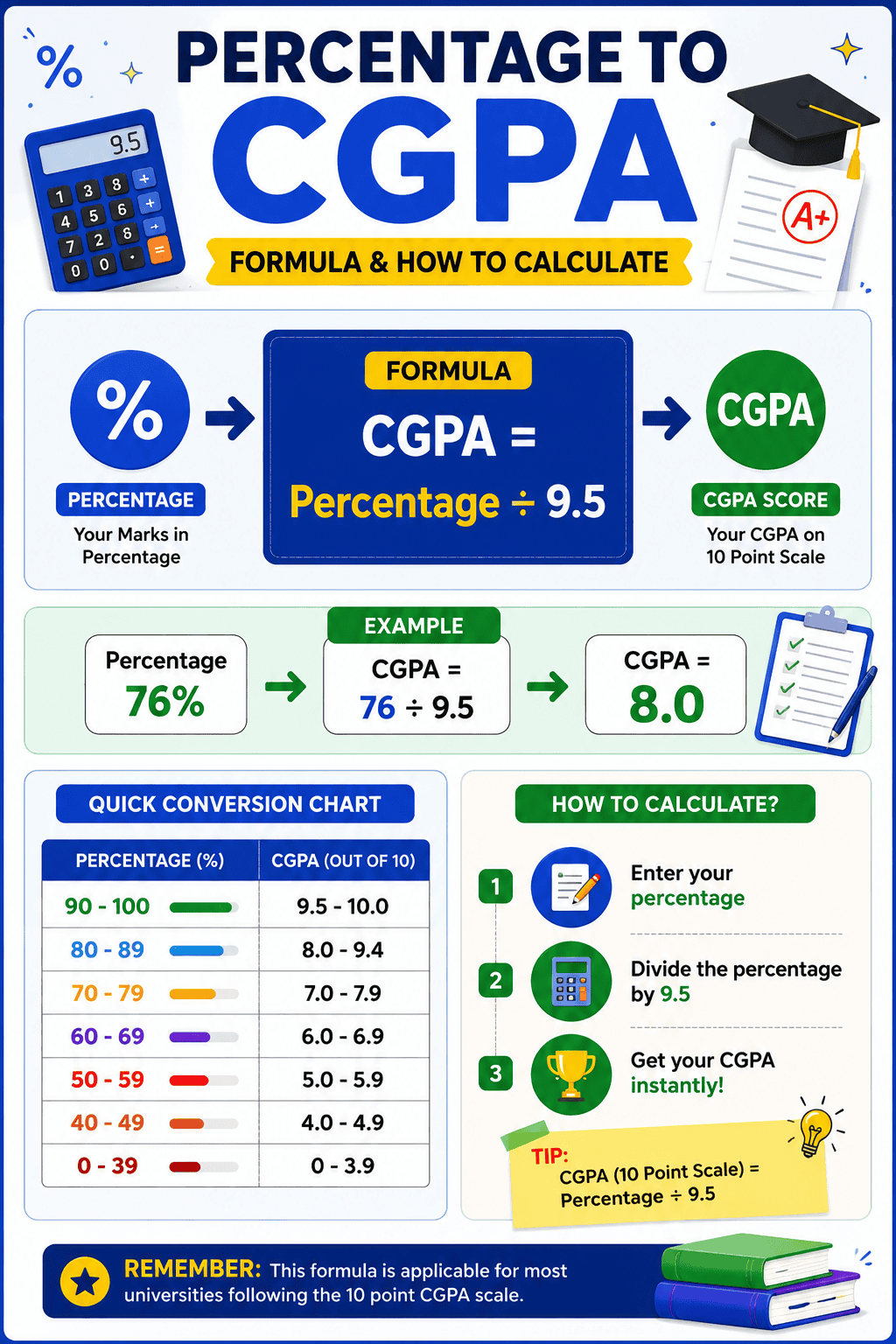
The percentage to CGPA formula used by CBSE and most Indian institutions is straightforward:
CGPA = Percentage ÷ 9.5
This is the official percentage to CGPA conversion formula endorsed by CBSE and recognized by AICTE. According to CBSE’s official guidelines, the 9.5 multiplier is derived from the mean marks of students who scored in the 91–100 range — the A1 grade band corresponding to a grade point of 10. Dividing the midpoint of that band (approximately 95) by 10 gives 9.5. That single number underpins the entire CBSE percentage to CGPA calculation.
For international applications, particularly to US and Canadian universities, the formula changes. The grade conversion calculator for a 4.0 scale uses: GPA = (Percentage ÷ 100) × 4. An 80% becomes a 3.2 GPA on the American scale. The math is always simple once you know which formula your target institution expects.
| Scale | Formula | Example (75%) |
|---|---|---|
| CBSE / AICTE (10-point) | CGPA = Percentage ÷ 9.5 | 75 ÷ 9.5 = 7.89 |
| US / Canada (4.0-point) | GPA = (Percentage ÷ 100) × 4 | (75 ÷ 100) × 4 = 3.0 |
| Calicut University | CGPA = Percentage ÷ 10 | 75 ÷ 10 = 7.5 |
| Anna University | CGPA = (Percentage ÷ 10) + 0.75 | (75 ÷ 10) + 0.75 = 8.25 |
How to Convert Percentage to CGPA
Converting percentage to CGPA takes three steps and less than a minute.
| Step | Action | Example |
|---|---|---|
| 1 | Note your exact percentage from your marksheet | 82% |
| 2 | Identify the correct formula for your board or university | CBSE: ÷ 9.5 |
| 3 | Divide and round to 2 decimal places | 82 ÷ 9.5 = 8.63 CGPA |
Here is the same process applied to an international scenario. Suppose you scored 78% and your college follows the CBSE standard. Your percentage to CGPA conversion gives: 78 ÷ 9.5 = 8.21 CGPA. If a German university then asks for a 4.0 GPA, you switch formulas: (78 ÷ 100) × 4 = 3.12 GPA. Same percentage, two different outputs — both correct, just calibrated for different contexts. This is exactly why a reliable percentage to CGPA calculator online is so useful during application season.
Percentage to CGPA Conversion Table
The percentage to CGPA chart below uses the standard CBSE formula (÷ 9.5) — the benchmark followed by the majority of Indian schools, colleges, and AICTE or UGC-affiliated universities.
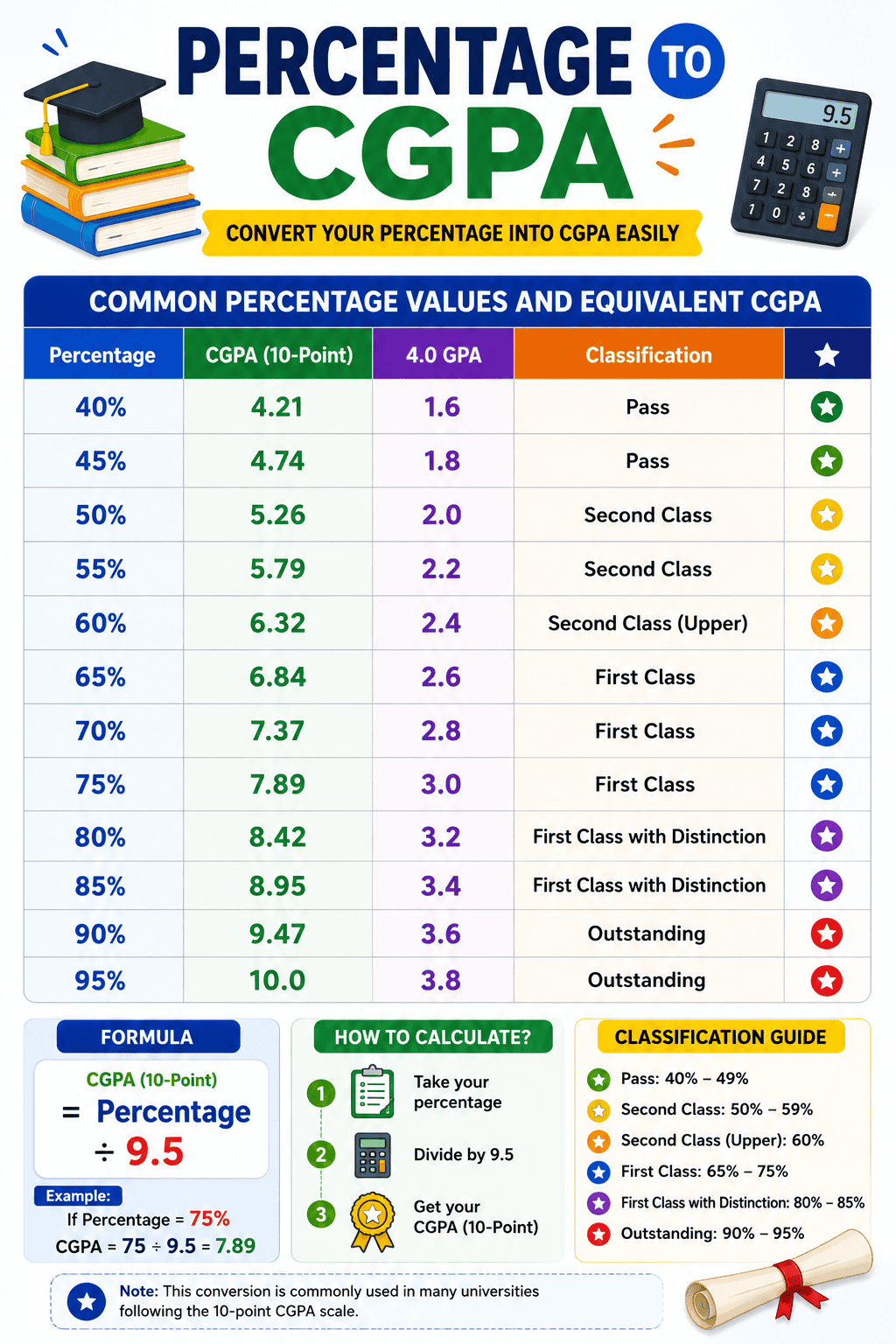
Common Percentage Values and Equivalent CGPA
| Percentage | CGPA (10-Point) | 4.0 GPA | Classification |
|---|---|---|---|
| 40% | 4.21 | 1.6 | Pass |
| 45% | 4.74 | 1.8 | Pass |
| 50% | 5.26 | 2.0 | Second Class |
| 55% | 5.79 | 2.2 | Second Class |
| 60% | 6.32 | 2.4 | Second Class (Upper) |
| 65% | 6.84 | 2.6 | First Class |
| 70% | 7.37 | 2.8 | First Class |
| 75% | 7.89 | 3.0 | First Class |
| 80% | 8.42 | 3.2 | First Class with Distinction |
| 85% | 8.95 | 3.4 | First Class with Distinction |
| 90% | 9.47 | 3.6 | Outstanding |
| 95% | 10.0 | 3.8 | Outstanding |
Quick Reference Chart
| CGPA Range | Percentage Equivalent | Academic Standing |
|---|---|---|
| 9.5 – 10.0 | 90% – 100% | Outstanding / O Grade |
| 8.5 – 9.4 | 80.75% – 89.3% | Excellent / A+ |
| 7.5 – 8.4 | 71.25% – 79.8% | Very Good / A |
| 6.5 – 7.4 | 61.75% – 70.3% | Good / B+ |
| 5.5 – 6.4 | 52.25% – 60.8% | Average / B |
| 4.0 – 5.4 | 38% – 51.3% | Pass / C |
| Below 4.0 | Below 38% | Fail |
Percentage to CGPA Examples
Real numbers make the percentage to CGPA conversion easier to grasp. Here are the six most commonly searched conversions among Indian students, each with context on what that score means in practice.
50% to CGPA
CGPA = 50 ÷ 9.5 = 5.26
A 50% score gives you a CGPA of 5.26 on the 10-point educational grading scale — Second Class category. On the 4.0 GPA scale, it equals 2.0. This is not a competitive score for selective programs abroad, but several graduate programs in Germany accept applicants from 55–60%, so options exist. Research specific cutoffs carefully before ruling anything out.
60% to CGPA
CGPA = 60 ÷ 9.5 = 6.32
Sixty percent is one of the most important academic thresholds for Indian students. It translates to a 6.32 CGPA — Second Class (Upper) — and equals 2.4 on the 4.0 scale. Most UK master’s programs set their minimum eligibility at exactly 60%. Germany accepts from 55%, and Canadian universities typically start at 60–70%. If your percentage score to CGPA lands here, there are real opportunities — you just need to target institutions whose cutoffs match your score.
70% to CGPA
CGPA = 70 ÷ 9.5 = 7.37
Seventy percent puts you at 7.37 CGPA — comfortably First Class. On the 4.0 scale, that is 2.8 GPA. This score clears most Indian PSU recruitment benchmarks, meets the eligibility bar for a wide range of postgraduate programs both in India and abroad, and satisfies the minimum criteria for most government job applications. Most students aim to stay at or above this mark throughout their degree for that reason.
80% to CGPA
CGPA = 80 ÷ 9.5 = 8.42
An 80% is a strong result by any standard — 8.42 CGPA, well into First Class with Distinction territory, and 3.2 on the 4.0 scale. At this level, UK universities open merit scholarship consideration, Australia’s Group of Eight universities become viable targets, and US MS or MBA programs are realistic. Many Indian companies visiting campuses for placements set a minimum CGPA cutoff between 7.5 and 8.0, so an 80% keeps you competitive across the board.
90% to CGPA
CGPA = 90 ÷ 9.5 = 9.47
Ninety percent is Outstanding — 9.47 CGPA, 3.6 on the 4.0 scale. At this level, virtually every global university’s minimum requirements are cleared with significant margin. Full scholarships, research fellowships, IITs, IIMs, and top-50 world universities all become realistic targets. Admissions committees read a score in this range as placing you among the top performers in your graduating class — which is precisely how they treat it.
95% to CGPA
CGPA = 95 ÷ 9.5 = 10.0
Ninety-five percent is a perfect 10 CGPA under the CBSE formula. On the 4.0 scale, it equals 3.8 GPA. Very few students in India reach this mark each year. At this level, full-ride scholarships, honors-level admissions, and the most selective doctoral programs worldwide are all within reach. The reason 95 divides to exactly 10.0 is intentional — CBSE designed the 9.5 multiplier around the mean score of A1-grade students, which averages approximately 95 marks.
Percentage to CGPA for Different Boards and Universities
India does not follow a single, unified grading framework. The percentage to CGPA conversion rules vary significantly depending on whether you studied under CBSE, a state university, or a technical institution. Submitting the wrong formula’s output on a foreign university application is a real and avoidable mistake.
CBSE Percentage to CGPA
The percentage to CGPA CBSE formula is the most standardized in the country: CGPA = Percentage ÷ 9.5. It is officially published in CBSE guidelines and accepted by most Indian colleges, scholarship portals, and DU admission forms. The CBSE percentage to CGPA converter logic applies primarily to Classes 9 and 10. For Class 11 and 12, CBSE issues marks directly — so 10th percentage to CGPA and 12th percentage to CGPA conversions are structurally different exercises. For Class 12, you apply the same ÷ 9.5 formula whenever a CGPA figure is needed for a college or entrance form.
The percentage to CGPA CBSE 12th conversion is especially relevant for students applying to Delhi University, central universities through CUET, or for state-level scholarship schemes that request CGPA equivalents. Even though CUET scores now drive most central university admissions, many state institutions and scholarship bodies still ask for a Class 12 CGPA figure. Knowing your equivalent CGPA in advance saves time and reduces errors during high-pressure application windows.
| CBSE Grade | Marks Range | Grade Point |
|---|---|---|
| A1 | 91 – 100 | 10 |
| A2 | 81 – 90 | 9 |
| B1 | 71 – 80 | 8 |
| B2 | 61 – 70 | 7 |
| C1 | 51 – 60 | 6 |
| C2 | 41 – 50 | 5 |
| D | 33 – 40 | 4 |
| E1 | 21 – 32 | — (Fail) |
| E2 | 0 – 20 | — (Fail) |
Source: CBSE Official Grading Guidelines
University Percentage to CGPA
University-level percentage to CGPA conversion is considerably more varied. Mumbai University officially states its formula as: Percentage = (CGPA − 0.75) × 10, which rearranges to CGPA = (Percentage ÷ 10) + 0.75. Savitribai Phule Pune University (SPPU) uses a similar approach: Percentage = (CGPA − 0.5) × 10, or equivalently CGPA = (Percentage ÷ 10) + 0.5. Calicut University applies a direct division by 10. GTU uses a separate institutional variant. These differences matter in practice — a 72% at Mumbai University gives a higher CGPA than the same 72% at Delhi University when each institution’s formula is applied correctly.
Before filling any postgraduate application, download your institution’s official transcript guide or verify the formula with your registrar’s office. Many foreign universities accept a percentage to CGPA conversion certificate — an official document from your institution confirming the equivalent CGPA alongside your percentage. Credential evaluation bodies like WES (World Education Services) or ECE (Educational Credential Evaluators) can also provide verified conversion reports when a target institution requires independent validation.
College Percentage to CGPA
Engineering colleges under Anna University — covering thousands of institutions across Tamil Nadu — use the formula: CGPA = (Percentage ÷ 10) + 0.75. A student with 72% computes: (72 ÷ 10) + 0.75 = 8.0 CGPA. That same 72% under the CBSE formula gives: 72 ÷ 9.5 = 7.58 CGPA — a meaningful gap of 0.42 points. VTU (Visvesvaraya Technological University), which governs engineering education across Karnataka, uses relative grading that cannot be reverse-engineered from percentage alone. Always request official documentation rather than self-converting.
Autonomous institutions add further complexity. BITS Pilani, Manipal Institute of Technology, VIT University, and SRM Institute each operate their own internal grading frameworks, with CGPA calculated from credit-weighted semester averages — not from percentage conversion at all. If you studied at any autonomous college, always attach an official conversion document from your university registrar when submitting applications. A certified conversion record carries far more weight with foreign admissions offices than a self-calculated figure.
Benefits of Using a Percentage to CGPA Calculator
Fast Results
Application deadlines hit hard. You do not want to be checking formula tables at midnight before a grad school submission. A percentage to CGPA calculator online delivers your result in under a second — no formula memorization, no risk of misremembering the divisor. Many percentage to CGPA calculator India tools now support multiple institutional formulas in a single interface, letting you see your CBSE CGPA, university CGPA, and 4.0 GPA equivalent side by side in one calculation. When semester results drop and thousands of students are checking their standing simultaneously, a reliable percentage to CGPA calculator online free tool is indispensable.
Beyond applications, speed serves everyday planning too. Knowing your CGPA equivalent immediately after results release means you can assess your options, compare requirements, and start planning your next steps — without waiting, without guessing, and without arithmetic errors.
Error-Free Conversion
Manual percentage to CGPA calculation is surprisingly easy to get wrong. A misplaced decimal or the wrong divisor can shift your CGPA by a full point. On a scholarship form with a cutoff of exactly 7.0 CGPA, the difference between 6.95 and 7.05 is the difference between qualifying and not qualifying. An automated score to CGPA calculator removes this risk entirely. The formula is fixed, the calculation is consistent, and the output is the same every time.
Accuracy matters even more for foreign university applications. Admissions teams at international institutions are well aware of conversion inconsistencies from Indian transcripts, and they do cross-check. A calculable arithmetic error — even an accidental one — can raise questions about your application’s reliability. A trusted grading percentage to CGPA calculator ensures every figure you submit is defensible.
Easy Academic Planning
A marks percentage to CGPA calculator is useful long before you reach the application stage. Want to graduate with an 8.5 CGPA? Work backward to figure out what percentage you need in your remaining semesters. Targeting the minimum 60% for a scholarship? Track your running average and adjust your study plan accordingly. Using the calculate cgpa from percentage formula proactively — rather than reactively — turns your academic results from a report card into a planning tool.
Students who monitor their CGPA equivalent throughout their degree consistently report setting clearer performance targets, prioritising subjects more deliberately, and feeling less anxious about results. The academic performance calculator function of these tools is not a luxury. For anyone with a specific academic goal, it is a practical necessity.
Common Percentage to CGPA Conversion Mistakes
Using the Wrong Formula
The most damaging mistake in percentage to CGPA conversion is applying the CBSE ÷ 9.5 formula to a non-CBSE institution. Anna University students who use the CBSE formula get a CGPA that is typically 0.3 to 0.5 points lower than their actual institutional CGPA. Submitting that figure to a foreign university understates your academic performance in a way that is entirely avoidable.
Consider this real-world scenario. A student from an Anna University-affiliated college scores 78%. Under the CBSE formula: 78 ÷ 9.5 = 8.21 CGPA. Under the Anna University formula: (78 ÷ 10) + 0.75 = 8.55 CGPA. That 0.34-point gap can determine scholarship eligibility at certain international institutions. Always confirm your institution’s specific formula before you convert percentage to CGPA for any official purpose.
Rounding Errors
Rounding your percentage before dividing is a subtle but common mistake. If you round 75.6% to 76% before applying the formula, you introduce a small inaccuracy that can compound across multiple conversions. The correct approach is to retain full decimal precision throughout the percentage to CGPA calculation and round only at the final step, typically to two decimal places. Any reputable percentage to CGPA calculator CBSE tool handles this automatically — which is another reason to use one rather than doing it manually.
Different Institution Rules
Some autonomous colleges cap CGPA at 9.0 or 9.5 for internal policy reasons. Others calculate from the best five subjects; others include all subjects. CBSE’s official rule is to compute CGPA from your best five — but some colleges request all six if you took an additional subject. These institutional variations are where most cgpa conversion from percentage errors originate. When in doubt, get an official conversion document from your registrar and include it with your application. A certified record always carries more authority than a self-calculated figure.
Percentage vs CGPA
Key Differences
Percentage and CGPA describe the same academic performance but communicate it differently to different audiences. Percentage is absolute, precise, and instantly understood by Indian stakeholders. CGPA is standardized, band-based, and recognized internationally. Neither is universally superior. Knowing when each system is expected, and being able to present your scores in both formats accurately, gives you an edge in every academic context.
| Feature | Percentage | CGPA |
|---|---|---|
| Scale | 0 – 100 | 0 – 10 (India), 0 – 4 (USA) |
| Representation | Raw marks ratio | Averaged grade points |
| Precision | Very high (every mark counts) | Moderate (grade band-based) |
| International use | Limited | Globally accepted |
| Stress factor | High | Lower |
| Common use in India | Entrance exams, government jobs | University transcripts, study abroad |
When Percentage Is Used
Percentage is the default for entrance exam eligibility across India. JEE, NEET, CUET, UPSC, SSC, banking exams, and most state-level competitive tests all state cutoffs in percentage. National scholarship schemes including the National Merit-cum-Means Scholarship (NMMS) and most state government merit awards require percentage. Government PSU recruitments, armed forces applications, and a large share of private sector job portals still use percentage as the primary eligibility metric. For day-to-day academic India, percentage remains the baseline.
When CGPA Is Used
CGPA becomes the operative measure the moment you move into postgraduate study or consider universities abroad. Every major foreign institution — from MIT to Oxford to TU Munich — evaluates applicants on a GPA or CGPA basis. Indian universities affiliated with AICTE and UGC increasingly issue semester marksheets in CGPA format as their primary record.
Campus placements at engineering colleges, management institutes, and research centres all rank candidates by CGPA. Fellowship applications, doctoral admissions, and academic promotions use cumulative grade point average as their benchmark. Knowing how to calculate CGPA from percentage marks accurately — and presenting it correctly for each context — is one of the most transferable academic skills you can build as a student in India.
Conclusion
The percentage to CGPA calculator is not a complicated tool. But using it correctly — with the right formula for your specific board or institution — makes a meaningful difference. Whether you are converting your CBSE Class 10 result, preparing a university application, or planning your GPA for a study abroad program, the principles in this guide give you everything you need. Always verify your institution’s official formula, use a trusted percentage to CGPA conversion online tool for quick checks, and request an official conversion certificate whenever a foreign institution requires it. Your marks are fixed. How accurately you present them is entirely in your hands.
Frequently Asked Questions
Q1. What is the percentage to CGPA formula for CBSE?
The official CBSE formula is: CGPA = Percentage ÷ 9.5. For example, 76% ÷ 9.5 = 8.0 CGPA. This formula applies to CBSE Class 9 and 10 results and is accepted by most Indian colleges and scholarship bodies as the standard conversion method.
Q2. Is the percentage to CGPA formula the same for all Indian universities?
No. CBSE uses Percentage ÷ 9.5. Anna University uses (Percentage ÷ 10) + 0.75. Mumbai University uses (Percentage ÷ 10) + 0.75 as well. SPPU (Pune University) uses (Percentage ÷ 10) + 0.5. Always check your specific institution’s official guidelines before submitting any application.
Q3. How do I convert 75% to CGPA?
Using the standard CBSE formula: 75 ÷ 9.5 = 7.89 CGPA. On a 4.0 GPA scale: (75 ÷ 100) × 4 = 3.0 GPA. If your institution uses a different formula, apply that instead — the result will differ.
Q4. What CGPA is 60%?
60% equals 6.32 CGPA on the CBSE 10-point scale (60 ÷ 9.5). This is the minimum threshold accepted by most UK master’s programs and many Canadian universities.
Q5. Do I need an official percentage to CGPA conversion certificate?
For most Indian college admissions and scholarship applications, a self-calculated figure using the official formula is sufficient. However, many foreign universities — particularly in the US, UK, and Canada — may ask for an official conversion certificate issued by your institution or verified by a credential evaluation service like WES or ECE. Check each institution’s specific requirements before applying.
Formula references: CBSE Official Guidelines | UGC Grading Framework | AICTE Regulations. Always verify current conversion rules with your institution before any official submission.