
Difference Between CGPA, SGPA, and Percentage (Complete Guide)
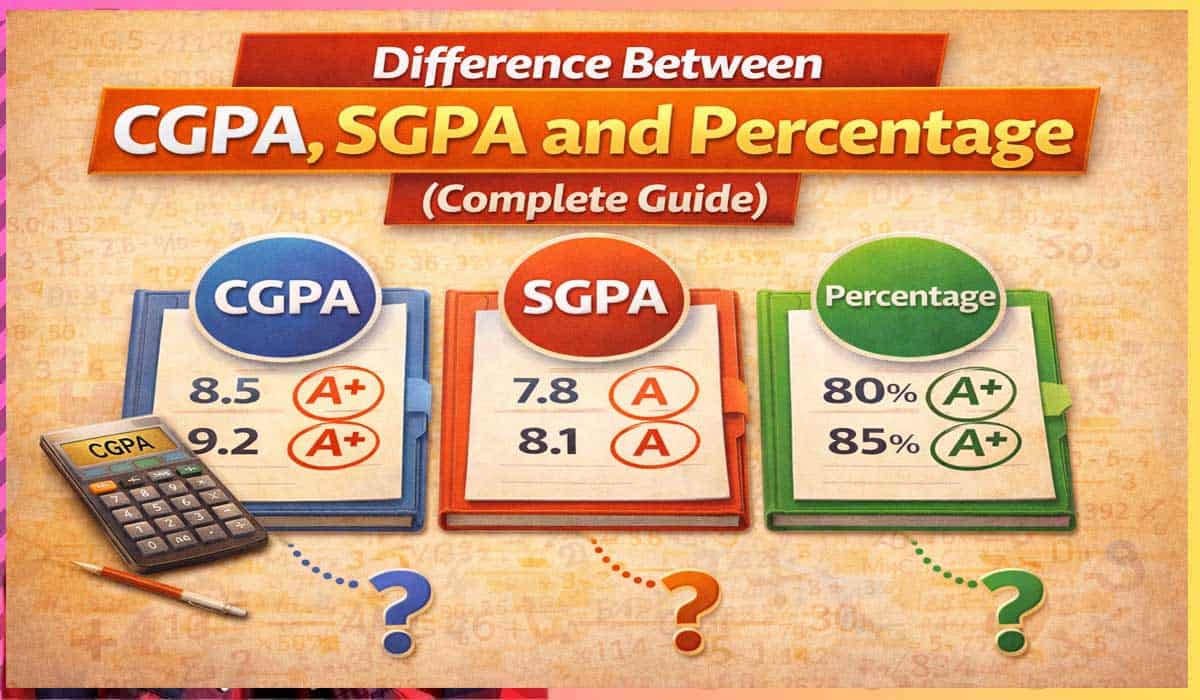
If you’re a student in India, you’ve probably heard these three words a hundred times – CGPA, SGPA, and Percentage. But honestly, most students don’t fully understand what they mean or how they’re different.
And that’s completely okay.
Maybe your college uses CGPA, but your friend’s college uses percentage. Or maybe you’re applying for a job and the form asks for your percentage – but you only have a CGPA. Confusing, right?
Don’t worry. In this guide, I’ll break it all down in the simplest way possible. No complicated math. No textbook language. Just clear, easy explanations that actually make sense.
Let’s get into it.
What is CGPA, SGPA, and Percentage?
Before we compare them, let’s understand what each one actually means.
Definition of CGPA (Cumulative Grade Point Average)
CGPA stands for Cumulative Grade Point Average.
In simple words, it’s your overall grade – calculated across all semesters of your course. So if you’re in a 4-year engineering program, your CGPA shows how you performed from the first semester all the way to the last.
Think of it like your overall report card for the entire course.
Most Indian universities – like those under UGC, CBSE, or NAAC – now use the CGPA system. It usually runs on a 10-point scale, where 10 is the highest you can get.
Definition of SGPA (Semester Grade Point Average)
SGPA stands for Semester Grade Point Average.
This one is simpler. It only measures your performance in one specific semester. So if you had a great third semester, your SGPA for that semester will be high – even if your other semesters weren’t as strong.
You might be thinking – “So SGPA is just a mini version of CGPA?” Yes, pretty much. Multiple SGPAs together are used to calculate your overall CGPA.
Definition of Percentage in Academic System
Percentage is the oldest and most common grading method in India.
It’s calculated out of 100. If you scored 75 out of 100 in all your subjects on average, your percentage is 75%.
Most school boards – like CBSE and state boards – still use percentage. Many government job applications and some private companies also ask for percentage instead of CGPA.
Key Difference Between CGPA, SGPA, and Percentage
Now let’s actually compare them side by side.
CGPA vs SGPA vs Percentage (Quick Comparison Table)
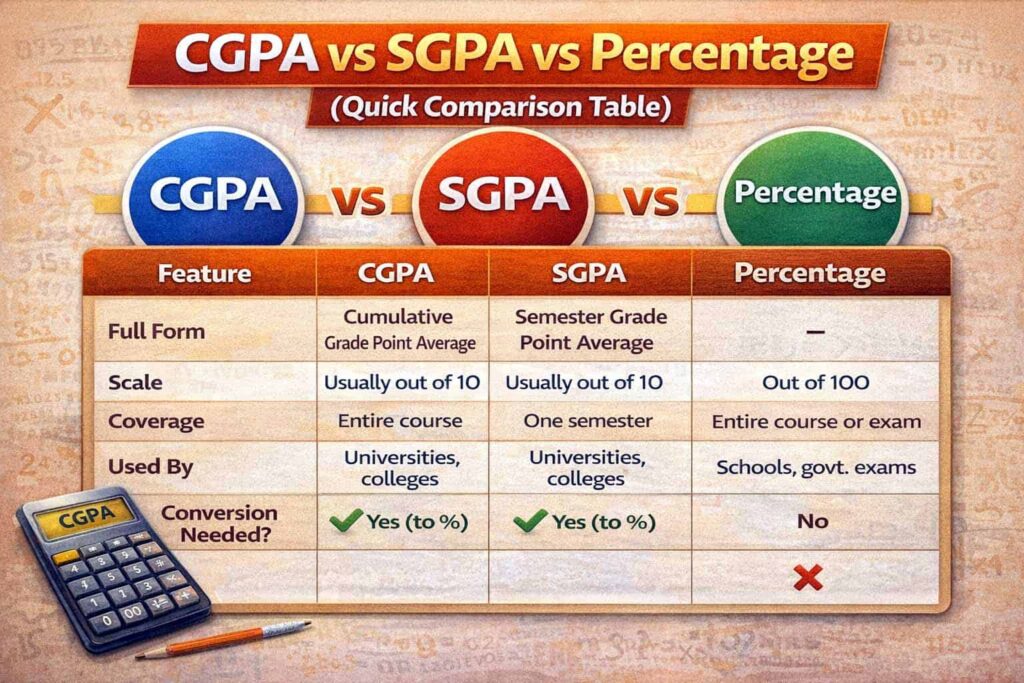
| Feature | CGPA | SGPA | Percentage |
|---|---|---|---|
| Full Form | Cumulative Grade Point Average | Semester Grade Point Average | – |
| Scale | Usually out of 10 | Usually out of 10 | Out of 100 |
| Coverage | Entire course | One semester | Entire course or exam |
| Used By | Universities, colleges | Universities, colleges | Schools, govt. exams |
| Conversion Needed? | Yes (to %) | Yes (to %) | No |
How Each System Measures Academic Performance
- CGPA measures your long-term academic consistency. It doesn’t change much with one bad semester.
- SGPA measures your short-term performance. One strong semester can give you a great SGPA.
- Percentage is a direct number. 85% means you answered 85 out of 100 marks on average. Clear and straightforward.
When and Where Each is Used
- CGPA is used in most Indian universities and colleges for degree certificates.
- SGPA is shown on your semester marksheet. You see it after every semester.
- Percentage is used in school results, SSC/UPSC applications, and many private job applications.
How CGPA is Calculated
Let’s understand the math. Don’t worry, it’s actually pretty simple.
CGPA Formula Explained
Here’s the basic formula:
CGPA = Sum of (Grade Points × Credit Points) for all subjects ÷ Total Credit Points
Each subject has a credit value (like 3, 4, or 5 credits depending on the course). And each subject also gives you a grade point (like 8 or 9 out of 10).
You multiply those, add them all up, and divide by the total credits.
Example of CGPA Calculation
Let’s say you have 3 subjects in a semester:
| Subject | Grade Point | Credit Points | Grade × Credit |
|---|---|---|---|
| Maths | 8 | 4 | 32 |
| Physics | 7 | 3 | 21 |
| English | 9 | 3 | 27 |
| Total | 10 | 80 |
SGPA = 80 ÷ 10 = 8.0
Now if you do this for all semesters and take a weighted average – that’s your CGPA.
Role of Credit Points in CGPA
Credit points are super important here. A subject with 4 credits matters more than a subject with 2 credits. So if you score well in high-credit subjects, your CGPA gets a bigger boost.
This is actually useful – it means core subjects carry more weight than minor ones.
How SGPA is Calculated
SGPA works the same way as the example above – but only for one semester.
SGPA Formula Explained
SGPA = Sum of (Grade Points × Credit Points) ÷ Total Credit Points in that semester
It’s the same formula, just limited to one semester’s data.
Example of SGPA Calculation
Using the same example from above – the SGPA would be 8.0 for that semester.
If you do well in Semester 1 and get an SGPA of 8.5, then have a tough Semester 2 with 7.0, your CGPA after two semesters will be somewhere in between (depending on credits).
Semester-Based Performance Evaluation
SGPA helps you track how you’re doing right now. It’s like a reality check every 6 months.
If your SGPA drops in one semester, you know something went wrong and you can fix it before it affects your overall CGPA too much.
How to Convert CGPA and SGPA into Percentage
This is probably what most students actually want to know. So let’s talk about it.
Standard Conversion Formula in India
Most universities in India follow this simple formula given by UGC (University Grants Commission):
Percentage = CGPA × 9.5
So if your CGPA is 8.0:
8.0 × 9.5 = 76%
That’s it. Simple multiplication. Here is online CGPA to Percentage and SGPA to Percentage Conversion tool
The same formula can also be used for SGPA if you want to convert a single semester’s score.
University-Specific Conversion Rules
Here’s the thing – not all universities follow the UGC formula.
For example:
- Anna University uses its own conversion method
- VTU (Visvesvaraya Technological University) has a different formula
- Mumbai University has yet another approach
So always check your university’s official website or marksheet for the correct formula. Don’t just assume it’s 9.5 everywhere.
Common Mistakes in Conversion
A few things students often get wrong:
- Using the wrong multiplier – always verify if your university uses 9.5 or something else
- Applying the SGPA formula to CGPA – they’re calculated the same way but represent different things
- Rounding too early – round off only at the final step, not in the middle of the calculation
CGPA vs Percentage – Which is Better?
Honestly, there’s no perfect answer. Both systems have their strengths.
Advantages of CGPA System
- Less pressure – one bad exam doesn’t ruin your entire result
- Focuses on overall learning, not just marks
- More flexible and internationally recognized
- Reduces unnecessary competition among students
Advantages of Percentage System
- Easy to understand – everyone knows what 80% means
- Directly shows how much you scored
- Widely accepted in government job applications
- No conversion needed
Which One is Preferred in Jobs and Placements
For campus placements, most companies ask for CGPA (usually a cutoff like 6.5 or 7.0 out of 10).
For government jobs (SSC, UPSC, bank exams), they usually ask for percentage.
For studying abroad, universities prefer CGPA – because they can compare it on a standard scale.
So it depends on where you’re going and what you’re applying for.
Importance of CGPA, SGPA, and Percentage in Careers
Your grades do matter. Maybe not everything – but they open doors, especially early in your career.
Role in Campus Placements
Most companies that come to college campuses set a minimum CGPA cutoff. If your CGPA is below that – say, below 6.5 – you might not even get to sit for the interview.
So during your college years, keeping your CGPA above a decent level is really important.
Importance for Government Jobs
Almost every government job application asks for your percentage in 10th, 12th, and graduation. Many also have minimum percentage criteria – like 50% or 60% – to even apply.
If your degree certificate shows CGPA, you’ll need to convert it and mention the equivalent percentage.
Impact on Higher Studies and Abroad Education
Planning to do an MBA or MS abroad? Then your CGPA matters a lot.
Universities in the USA, UK, Canada, and Australia look at your CGPA when deciding admissions. A CGPA above 7.5 or 8.0 (out of 10) is generally considered good for most programs.
Some universities have a minimum CGPA requirement too – usually around 6.0 or 6.5.
Common Confusion Students Have
Let me address the stuff that trips everyone up.
Is CGPA Same as Percentage?
No, they are not the same.
CGPA is a point-based system (out of 10). Percentage is out of 100. You can convert CGPA to percentage using a formula, but they’re calculated differently.
A CGPA of 7.5 roughly equals 71.25% – but they don’t represent the same thing directly.
Can SGPA Be Higher Than CGPA?
Yes, absolutely.
If you performed really well in one particular semester, your SGPA for that semester can be higher than your overall CGPA. For example, your CGPA might be 7.2 but your SGPA in Semester 5 might be 8.5.
It works the other way too – a bad semester can have a lower SGPA than your CGPA.
Which One Should You Focus On?
Focus on your SGPA every semester – because that’s what you can control right now. If you keep your SGPA consistently good, your CGPA will naturally stay healthy too.
Don’t panic about your CGPA every day. Just do well in your current semester. That’s the simplest strategy.
Final Thoughts on CGPA, SGPA, and Percentage
Key Takeaways for Students
- CGPA = Overall grade for your entire course (out of 10)
- SGPA = Grade for one semester (out of 10)
- Percentage = Score out of 100 – old but still widely used
- To convert CGPA to percentage: multiply by 9.5 (check your university’s formula)
- Campus placements usually need CGPA; government jobs usually need percentage
Best Way to Track Academic Performance
The smartest way? Keep an eye on both SGPA and CGPA together.
After every semester, check your SGPA. If it’s going down, figure out why. Which subjects? Which topics? Fix it early.
And once in a while, calculate your running CGPA so you know where you stand overall. There are many free CGPA calculators online – use them.
Your grades are just one part of your story, but they’re a part that’s fully in your control. So track them smartly.
Frequently Asked Questions (FAQs)
What is the difference between CGPA and SGPA?
CGPA covers your entire course – all semesters combined. SGPA only covers one semester. Think of SGPA as a chapter, and CGPA as the whole book.
How to convert CGPA into percentage?
Use this formula: Percentage = CGPA × 9.5. But always double-check your university’s official conversion method, as some universities use a different multiplier.
Which is more important, CGPA or percentage?
It depends on your goal. For campus placements and abroad education, CGPA matters more. For government jobs and many private applications, percentage is what they ask for. Ideally, know both.
Is SGPA important for final results?
Yes. Your SGPA from every semester is used to calculate your final CGPA. So a consistently good SGPA across all semesters means a solid CGPA at the end. Don’t ignore it just because it’s “only one semester.”