The Concept of CGPA in India: History, Introduction & Importance Explained (2026 Guide)

The Concept of CGPA in India: If you’re a student in India, you’ve probably heard the word “CGPA” many times. Maybe your teacher mentioned it. Maybe you saw it on your report card. But do you really know what it means and where it came from?
Don’t worry – you’re not alone.
A lot of students (and even parents) get confused between CGPA, percentage, and grades. It all sounds complicated at first. But once you understand it simply, it actually makes a lot of sense.
In this guide, we’ll break down everything – what CGPA is, when it started in India, why it was introduced, and whether it’s still useful today. Let’s get into it.
What is CGPA? (Basic Concept Explained)
Definition of CGPA in Simple Terms
CGPA stands for Cumulative Grade Point Average.
In simple words, it’s a number that shows your overall academic performance. Instead of showing how many marks you scored, it shows your average grade points across all subjects.
Think of it like this – instead of saying “I scored 78 out of 100,” you say “My CGPA is 7.8.” It’s a cleaner and simpler way to measure how well you’re doing in school or college.
The scale usually goes from 0 to 10 in most Indian schools and universities.
How CGPA is Calculated in India
So how exactly is it calculated? Let’s understand this step by step.
Every subject is given a grade point based on your marks. Then, the average of all those grade points is calculated. That average is your CGPA.
Here’s a simple example:
| Subject | Grade Point |
|---|---|
| Maths | 9 |
| Science | 8 |
| English | 7 |
| Hindi | 8 |
| Social Science | 9 |
CGPA = (9+8+7+8+9) ÷ 5 = 8.2
So your CGPA would be 8.2 out of 10. Simple, right?
If you want to calculate CGPA online, use our tool: CGPA to Percentage Calculator Online
Difference Between CGPA, SGPA, and Percentage
You might be thinking – what about SGPA? And how is CGPA different from percentage?
Here’s a quick breakdown:
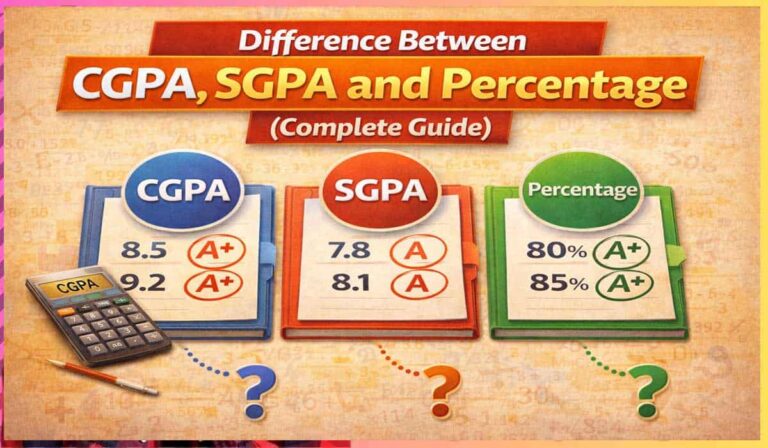
- CGPA = Average grade points across all semesters or years
- SGPA = Average grade points for one semester only
- Percentage = Your actual marks shown as a percentage (like 78%)
So SGPA is for one semester. CGPA is the bigger picture – it covers your entire course. And percentage is the old-school method that most of us grew up hearing about.
When Was the CGPA System Introduced in India?
Introduction of CGPA by CBSE
The Central Board of Secondary Education (CBSE) was the first major board in India to officially introduce the CGPA system.
This happened at the school level, mainly for Class 10 students. It was a big change – and not everyone was happy about it at first. But there were solid reasons behind it.
Year and Background of Implementation
CBSE introduced the CGPA system for Class 10 board exams in 2009-2010.
Before this, students had to appear for board exams and were given marks and a percentage. The competition was intense. Students were under huge pressure to score high marks.
The government and education experts started noticing that this pressure was doing more harm than good. So, a new system was brought in – one that focused less on a single number and more on overall learning.
Reasons Behind Replacing the Percentage System
Why fix something that was working for decades? Well, because it wasn’t really working well for students.
Here’s what the problems were:
- Students were getting too stressed about marks
- One bad exam could ruin a student’s entire academic record
- There was too much focus on memorizing and not enough on understanding
- Mental health issues among students were increasing
- Comparison between students was getting unhealthy
The CGPA system was meant to solve all of these issues – or at least reduce them.
Why Was the CGPA System Introduced in India?
Reducing Academic Pressure on Students
This is probably the biggest reason.
In the old system, if you scored 74% instead of 75%, it felt like a disaster. Students used to cry over single marks. Parents used to compare their kids with neighbors. It was a lot.
CGPA changed that. Instead of exact marks, students get grade points. A student with 91 marks and a student with 95 marks might both get the same grade point (say, A1 = 10). So the pressure of chasing every single mark goes away.
Focus on Overall Performance Instead of Marks
The CGPA system looks at your performance across all subjects and all terms – not just one exam.
So even if you had a bad day during one test, your overall CGPA won’t crash. It balances things out. This encourages students to stay consistent throughout the year instead of going all-out only during final exams.
Also, it reduces the idea that one exam defines your entire worth as a student. That’s a good thing.
Encouraging Skill-Based Learning
With the old percentage system, the focus was mostly on: read, memorize, write, repeat.
CGPA introduced the idea that learning should be more than that. Schools started adding co-curricular activities, projects, and internal assessments to the grading system.
For example, your grade in a subject might include:
- Written exam
- Project work
- Class participation
- Lab work (for science)
This way, students who are good at practical work but nervous during exams still get a fair chance.
Who Introduced the CGPA System in India?
Role of CBSE Board
The credit for formally introducing CGPA at the school level in India goes to CBSE. They rolled it out under the Continuous and Comprehensive Evaluation (CCE) framework in 2009.
CCE was a big reform. It changed the way schools evaluated students – from just marks-based exams to a mix of tests, projects, and activities throughout the year.
Influence of Global Education Systems
India didn’t come up with this idea on its own. The CGPA system is widely used across the world – especially in the USA, UK, Canada, and Australia.
In these countries, universities have been using GPA (Grade Point Average) for a very long time. Indian universities and education boards looked at these global models and decided to adapt something similar for Indian students.
The idea was to make Indian education more modern and globally compatible – especially for students who want to study abroad later.
Adoption by Universities and Other Boards
After CBSE, many other boards and universities also adopted the CGPA system.
- UGC (University Grants Commission) made it mandatory for Indian universities to use the 10-point CGPA scale
- AICTE also adopted similar grading norms for engineering and technical colleges
- State boards slowly started moving toward grade-based systems too
Today, almost every college and university in India uses CGPA in some form.
How CGPA System Works in Indian Education
Grade Points and Credit System Explained
In India, CGPA works on a 10-point scale. Each grade corresponds to a range of marks and a grade point.
Here’s a typical CBSE-style grading table:
| Marks Range | Grade | Grade Point |
|---|---|---|
| 91-100 | A1 | 10 |
| 81-90 | A2 | 9 |
| 71-80 | B1 | 8 |
| 61-70 | B2 | 7 |
| 51-60 | C1 | 6 |
| 41-50 | C2 | 5 |
| 33-40 | D | 4 |
| Below 33 | E (Fail) | – |
In colleges and universities, a credit system is also used. Each subject has a certain number of credits based on how many hours are spent on it per week. More important or heavy subjects have more credits.
CGPA Calculation Formula Used in India
For schools (CBSE style):
CGPA = Sum of Grade Points in all subjects ÷ Number of Subjects
For colleges (with credit system):
CGPA = Sum of (Grade Point × Credits) ÷ Total Credits
The college formula gives more weight to subjects that have more credits. So a subject worth 5 credits matters more than one worth 2 credits.
Examples of CGPA Calculation
School Example (CBSE):
Subjects: Maths (9), Science (8), English (8), Hindi (7), SST (9)
CGPA = (9+8+8+7+9) ÷ 5 = 8.2
College Example (with credits):
| Subject | Grade Point | Credits | GP × Credits |
|---|---|---|---|
| Maths | 9 | 4 | 36 |
| Physics | 8 | 3 | 24 |
| English | 7 | 2 | 14 |
| Total | 9 | 74 |
CGPA = 74 ÷ 9 = 8.22
Advantages of CGPA System in India
Less Exam Stress for Students
This is the most talked-about benefit – and for good reason.
When students know that one exam won’t make or break their grade, they relax a little. They study better. They sleep better. And honestly, they learn better too.
The CGPA system includes internal assessments throughout the year, so students stay engaged – not just during finals.
Better Evaluation of Overall Performance
CGPA doesn’t just look at one test. It looks at:
- Multiple exams
- Projects and assignments
- Practical work
- Sometimes, attendance and participation
So it gives a much more complete picture of a student. A student who consistently does well throughout the year is rewarded – not just the one who crammed the night before.
Simplified Academic Assessment
For schools and colleges, managing CGPA is cleaner than managing raw marks.
Comparing students across different states or universities also becomes easier when everyone uses the same 10-point scale. And when Indian students apply to foreign universities, CGPA is a format those institutions already understand.
Disadvantages of CGPA System in India
Lack of Detailed Performance Insight
Here’s the flip side.
If two students both have a CGPA of 8.0, you can’t really tell who performed better. One might have scored 85% in every subject. Another might have scored 91% in some and 74% in others. The CGPA looks the same.
This lack of detail can be a problem – especially when students are competing for limited seats in colleges or jobs.
Confusion in Conversion to Percentage
Many employers and entrance exams still ask for a percentage. But converting CGPA to percentage isn’t always straightforward.
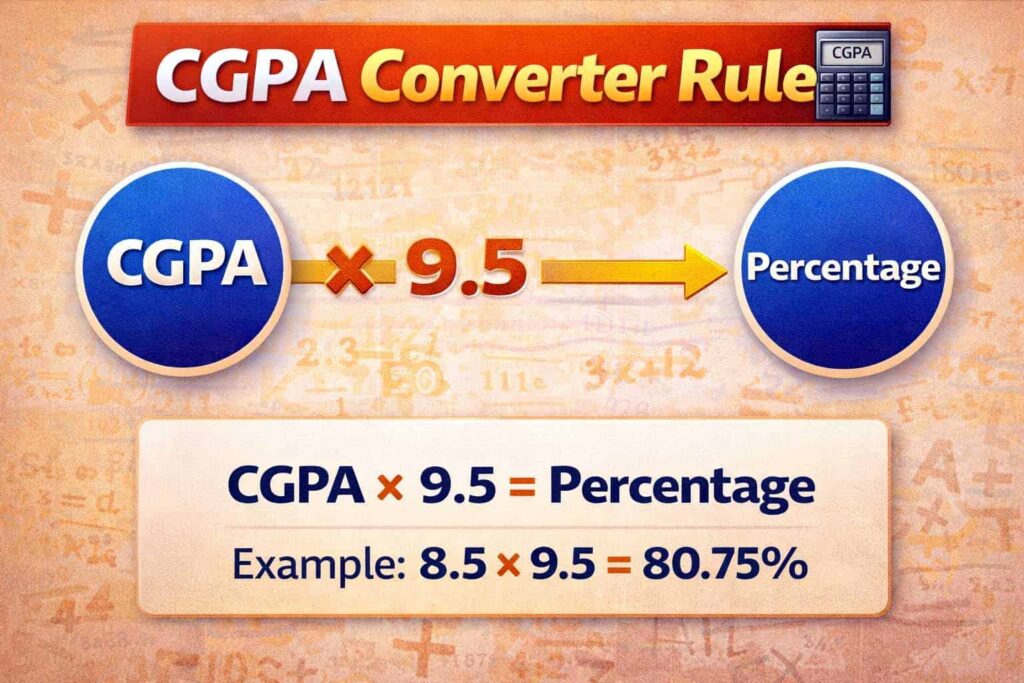
CBSE’s official formula is:
Percentage = CGPA × 9.5
So a CGPA of 8.0 = 76%.
But different universities use different conversion methods. Some multiply by 9.5, some by 10, and some have their own formulas. This creates confusion – especially for students applying to multiple places.
Issues Faced by Students and Recruiters
Recruiters from private companies often prefer percentages because it’s what they understand. When a student says “I have a CGPA of 7.5,” the recruiter might not know if that’s good or average.
Also, students moving from one university to another (or going abroad) sometimes face issues because different institutions use different CGPA scales. A 7.5 at one university might not mean the same as a 7.5 at another.
CGPA vs Percentage System in India
Key Differences Between CGPA and Marks
| Feature | CGPA | Percentage |
|---|---|---|
| Scale | 0 to 10 | 0 to 100 |
| Focus | Overall average | Exact marks |
| Stress level | Lower | Higher |
| Widely understood | Globally | Locally |
| Detail | Less | More |
Which System is Better for Students?
Honestly? Both have their place.
CGPA is better for reducing stress and giving a fair picture of long-term performance. But the percentage system is clearer and easier to understand for most people.
A lot of experts say the best approach is a mix – use CGPA for learning and evaluation, but also show detailed marks when needed. Some universities in India are already doing this.
Impact on Higher Studies and Jobs
For higher studies – CGPA is very useful. Most foreign universities ask for GPA or CGPA. Indian universities also use CGPA for admissions and scholarships.
For jobs – it depends on the company. Some companies (especially MNCs and IT firms) accept CGPA. Others still ask for a minimum percentage. Government jobs often use percentage as the criteria.
So knowing how to convert your CGPA to percentage is an important skill every student should have.
Is CGPA Still Relevant in India Today?
Current Status of CGPA in Schools and Colleges
Yes, CGPA is still used widely across India in 2026.
Almost all central universities, IITs, NITs, and private colleges use the 10-point CGPA system. CBSE schools use grade-based evaluation. The system has become a core part of how India measures academic performance.
However, CBSE did bring back board exams for Class 10 in 2017, which moved somewhat away from the pure CCE-CGPA model. But the grading system itself is still used.
Changes in NEP (New Education Policy)
The New Education Policy (NEP) 2020 has brought some new ideas to the table.
NEP 2020 focuses on:
- Competency-based learning over rote memorization
- Holistic development of students
- Flexible curriculum and assessment
- Reducing the importance of board exams
Under NEP, the evaluation system is expected to become more comprehensive – combining CGPA-style continuous assessment with skill-based evaluation. So CGPA isn’t going away anytime soon. It’s actually evolving.
Future of Grading Systems in India
The future looks like a mix of CGPA, skill assessments, and digital portfolios.
As India moves toward a more modern education system, the focus will likely shift from “what marks did you get” to “what can you actually do.” CGPA will continue to play a role, but it will probably be supported by more detailed evaluation methods.
Final Thoughts on CGPA Concept in India
Key Takeaways for Students
Let’s wrap this up simply:
- CGPA = Cumulative Grade Point Average (scale of 0-10)
- It was introduced by CBSE in 2009-10 under the CCE framework
- The main goal was to reduce stress and encourage balanced learning
- It looks at overall performance, not just one exam
- Converting CGPA to percentage: CGPA × 9.5
- It’s widely used in Indian schools, colleges, and universities
Importance of Understanding CGPA System
Whether you’re a student, parent, or even a recruiter – understanding CGPA matters.
For students, it helps you know where you stand and how to improve. For parents, it helps you support your child without putting unnecessary pressure on them. For recruiters, it helps you evaluate candidates more fairly.
The CGPA system isn’t perfect. But it was a step in the right direction – away from mark-chasing, toward real learning. And that’s something worth understanding.
Frequently Asked Questions (FAQs)
What is the full form of CGPA?
CGPA stands for Cumulative Grade Point Average. It’s the average of all your grade points across subjects and semesters.
When did CBSE introduce CGPA in India?
CBSE introduced the CGPA system for Class 10 students in 2009-2010 as part of the Continuous and Comprehensive Evaluation (CCE) policy.
Why was CGPA introduced in India?
It was introduced mainly to reduce exam stress among students, encourage overall development, and shift focus from memorizing to actually learning and understanding subjects.
Is CGPA better than the percentage system?
It depends on the situation. CGPA is better for overall evaluation and reducing pressure. But the percentage system is clearer and easier for employers and admissions teams to understand. Ideally, both should work together.